Pre-K:
We have been finishing up animals in Ms. Hernandez's. This is one of the habitats we made. It's the arctic. the students painted on acetate and then cut the acetate into triangles, working on their understanding of shape and their fine motor skills.
We have been finishing up animals in Ms. Hernandez's. This is one of the habitats we made. It's the arctic. the students painted on acetate and then cut the acetate into triangles, working on their understanding of shape and their fine motor skills.
They then glued the pieces onto a drawing of mountains and water they did to show the arctic environment.


We are now working on our study of plants. We asked the students what they would like to make to learn more about plants and to show their understanding of plants.
The students in Mrs. Bennett's group decided they wanted to paint or create clay flowers. The painting group came to the atelier and created observational paintings of flowers. We thought it would be nice to make a large mural of all of their paintings on acetate so it can decorate the office window. That will be our next step.

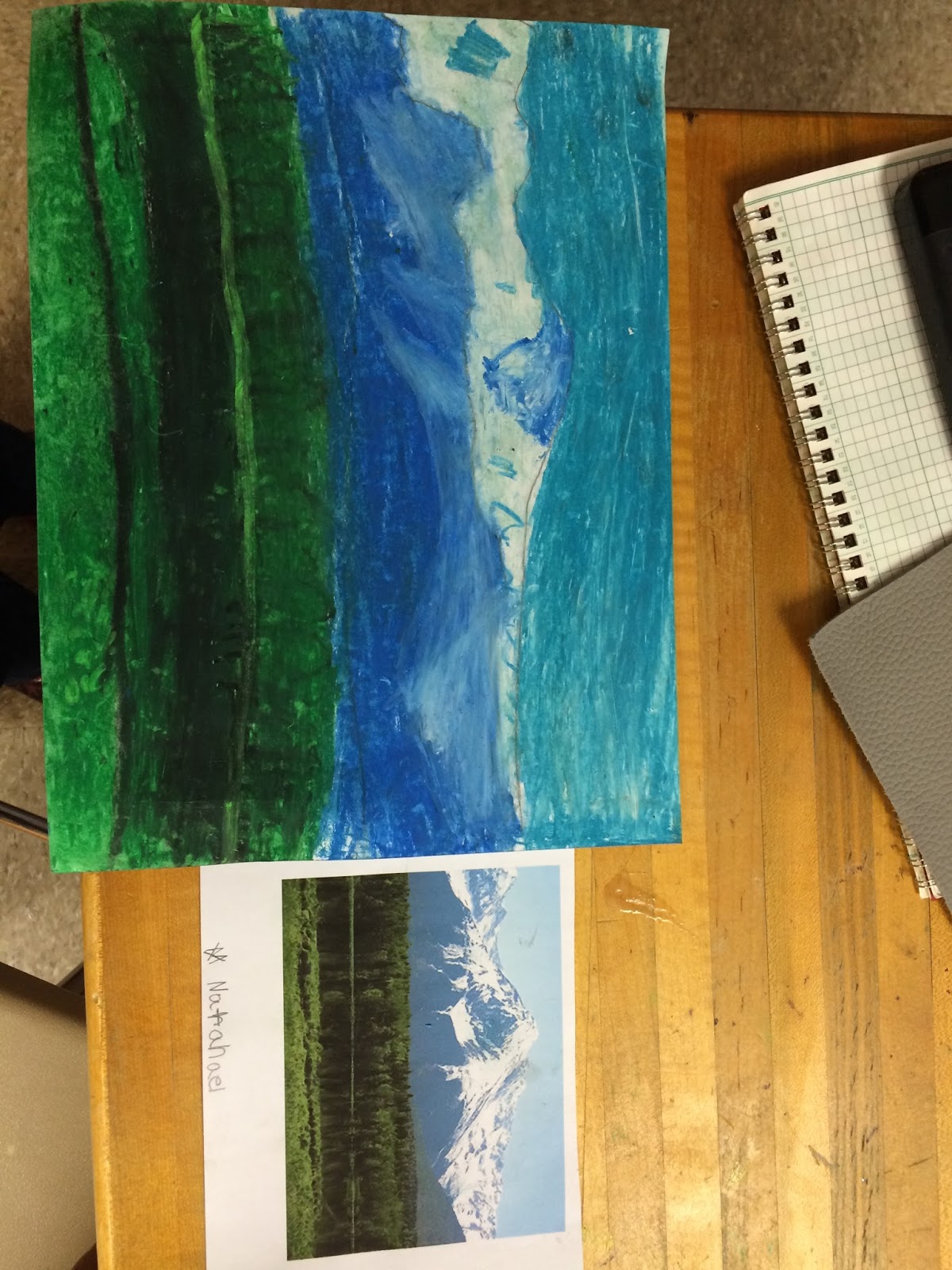
In Ms. Lopez's class, we studied the work of Oscar Ortiz. The students created oil pastel drawings based on his style.

Kindergarten
We had a great experience on a nature hike. We went for our first Spring hike in the valley nature trail. We made theories about the rocks near the river and we saw a snake(!) and snails.


The highlight of the walk was this tree, though!


To our surprise, we have a beaver living in the nature area! We were so excited that when we told other teachers about it, they decided to take their classes out the next day. We went for a walk with pre-k, first grade and fifth grade the next day. More on that in a bit.
When I returned from the second walk, I showed images to the kindergarten classes. After a discussion about the beaver, one student, Jacob said:
We need to go to the studio to learn about the science of this.
The next time I had them, I brought that student and a few friends to the studio and asked them what they wanted to do to learn more about beavers or share what they know. Araceli had the bright idea of using clay to create the tree and Jacob decided to create the beaver.
Jacob worked diligently, referring to images on the iPad over and over again, to create a beaver that he felt was pretty accurate (and I was really impressed by both his work ethic and at how well this came out. I don't know if I could do as well of a job!)


First Grade
First grade has been working with loose parts to create modes of transportation.


Second Grade
Second Grade is in the middle of a HUGE project that was inspired by a walk to the nature trail. The students were very curious about the old railroad bridge ruins that are on the walking path we take sometimes. They wanted to know what they were. This led to an investigation into the history of the area, including Silo City, which spawned a real interest in certain historical components. The students divided themselves into groups to study different parts of history. The groups are Fashion, Architecture, Education, Transportation and Entertainment.
I asked the students what they wanted to make to show the rest of the world what they're learning from their research. The kids have BIG ideas and it's exciting to see what they think of. I really love the idea of turning it over to them.
Fashion decided to make paper dolls (Laminated, so they don't break- Johnomar.) They used two pre-k students and two teachers from our building as the template for the dolls. They researched different historical periods: Native Americans, Colonial, Victorian, the 1920s were the groups they started to focus on the most.
 |
| Lucky Ms. Santiago won the vote to be the woman doll model. |
The students traced the dolls on the light table to make sure the clothing would fit. They then chose a style from the period they were interested in and tried to create a drawing that resembled that style.
The school group met with me next. They created drawings of one room school houses and then created a model before moving on to build a full-sized play one room school house for the pre-k students. They were going to make it to scale, using a one inch to one foot ratio, but after the model was complete and I took them to look at the cardboard panels, they decided that would be way too big! The model was 7" squared. They asked me if we could cut the panels in half, making a 3.5 foot square one room school house and we agreed that was a more manageable size. I can't wait to see what they come up with to construct this play house. I try to facilitate and not direct, so it's always exciting to see them figure a concept out for themselves.

The architecture and transportation groups will create something like the model school house, but I will probably be more critical of the aesthetics. That masking tape won't work for a finished product!
The entertainment group wants to research entertainment throughout history and then put on a performance on the stage. I love this idea and can't wait to work with them on it!
Other news:
Our art show is coming up quickly. It is at the Albright Knox Art Gallery and will open June 1st. It will run through June 19th. We will be there on June 3rd, for First Friday, which offers free admission and fun activities. This will be the opening reception of the show. We are starting to put the panels together now and they're looking good. :)