Español

Monday, October 28, 2013

Monday, October 28, 2013

120, bilingual first grade. I took a small group to the studio to work on portraits. I'm really pleased with the way these portraits are coming along.
Pretty amazing for a first grader, don't you think? 

108, monolingual first grade. I brought a group into the studio to continue our work on building the community. The first group made two houses and a pet store.  This group made a video game shop, a Walmart, a doctor's office and a gym.
Our Gym

This is going to be a video game store.

The beginnings of our Walmart.

118, monolingual second grade. I brought the same small group I had last week into the studio to continue working on building a model of our school playground out of clay.  They went from wanting to work alone, to wanting to work as partners to deciding to work as a whole group.  We will have one playground model, with each student contributing a part.  I love that they decided to collaborate.  The atmosphere changed this time around, too.  I heard a lot of encouraging praise and the critiques were constructive and positive.  I am really happy with the progress they're making.
Our monkey bars are complete. The slides are created, but not attached.  We're making lots of progress.

102, monolingual kindergarten. I brought half of the class to the studio to paint realistic portraits of themselves, as their unit in the classroom is All About Me.  We chose colors that match our skin tone, mixing the multicultural paint colors when necessary. The students painted their faces with the skin color, then I demonstrated how to make realistic eyes using white, the iris color and black.  We also discussed hair color and tried to match up our actual hair color and hairstyles.  I thought the results were pretty awesome.


101, preschool. I had them complete their primary-turned-secondary color mixing lesson today. Instead of stenciling or stamping, the students etched their first initial into the paint, which is something they were working on in class, so I figured we could reinforce it through the exploration of materials in art.


Friday, October 25, 2013

Friday, October 25, 2013

116, bilingual second grade.  I took a group of students to the computer lab.  We learned how to log on and search for images on google. I've learned that technical difficulties come with the territory when you are working with computers, so we had issues printing and saving our images.  I just wrote down the web addresses and I hope to find their images and print from there.  I gave the students pens and paper and they began drawing their living things right from the computer.  I will repeat this with another group on Monday.

118, monolingual second grade. The students were preparing to leave for a field trip, so I used the time to write a lesson plan for where the community project is heading.

108, monolingual first grade.  Our school practiced a lockdown, which ended up taking up this period.  In this day and age, lockdown is a necessity, even if the most creative, Reggio-inspired schools.

I was able to get the pre-k and k letters project all formatted and now I'm researching to find a way to print copies of our letter book in an economical fashion.


Thursday, October 24, 2013

Thursday, October 24, 2013

Today was one of those days where the inspiration is almost tangible with these students. I decided that since the clay is already out and my room is in a state of dusty chaos, now is a good time to explore clay with a few other classes.

120, bilingual first grade, continued with their small group portraits.  Not much to report until those are completed. :)

118, monolingual second grade.  This class just finished drawing the buildings around our community as part of their observational drawing skills and their social studies curriculum.  We incorporated mathematical concepts, such as visually measuring using your pen or pencil to get proportions correct when drawing from life.  I think this reinforcement from a visual arts perspective is really hitting the curriculum home.  I brought the group who drew the playground to the studio and gave them clay and photographs of the playground.  I showed them architectural drawings, blueprints and then 3D models, explaining what each of those components are.  The students knew 3D only as a way to watch movies, so it was interesting to talk about height, width and depth with them.  When I brought the clay out, they knew it could be used to make the playground in 3D and I didn't have to say a word.

We talked about angles and measurement again and I was so excited to see that the angled monkey bars were being recreated with nearly the same angle as in the photograph and real life!

The kids decided to work in groups and both groups were using the similar angles and proportions. I can't wait to see the finished pieces!


108- monolingual first grade.  I've been using an exploratory approach to this class and today I thought, "Why not start with clay and tie in communities?" We did a taxonomy of places in the community and the students started building some places for community helpers to work.  I have a feeling this could lead into a community space with murals for the streets and background, street lights, maps, and a huge project might grow out of it.  


116, bilingual second grade- I took Group One to start drawing the non-living things in our community.  The school was the first choice and the church was the second.  We now have two huge drawings started of these buildings.  The students are using their drawing from observation skills to draw from photographs.  Tomorrow, we'll go to the computer lab to research images of our living things, which I will print so we can draw and paint them from observation.

103, preschool. The students have about learned color mixing using tempera paint, so I wanted to give them an opportunity to explore with all three primary colors. I set up areas where students could paint in groups and let them choose the subject matter.  Most of them practiced mixing colors.  I saw a letter A and some faces.  Two girls drew themselves and the other. "We are working together! This is fun!" They painted themselves near an apple tree.  A boy painted himself in his Halloween costume. 

"Me and my friend are by the apple tree."

A happy little guy.


Another first attempt at a face.

102, monolingual kindergarten. I took the students who didn't make self-portraits out of clay yesterday. 


"I made my legs crossed."

"This is me. And this is my pizza."

A nice seated figure.

The children of Room 102 in clay!


I've had a number of projects finish at the same time, so I've been on a crazy hanging/installation kick. Room 104 finished their tree, so we installed that today.  The students are going to find the biggest, most colorful leaves they can find at home and bring them in to hang on our tree.  The three will change as the seasons and projects change. 


Wednesday, October 23, 2013

118, monolingual second grade. I took half of the class to finish their portraits, but it became clear that we will need one more day.

112, self-contained. We continued our study of the continents.

116, bilingual second grade.  We hung our cloud murals in the room.  Now we are ready to begin our study of things in the School #33 community.  We will start with a drawing of the school.  Each student will then do an observational drawing of a living or non-living thing in our community that they've researched.


120, bilingual first grade. We created menus for the class kitchen area, which is turning into a restaurant like the other first grade class has.

102, monolingual kindergarten. We continued their exploration of materials and tied it into their social studies theme of "myself."  The students were given clay and clay tools and asked to create something that represented themselves. They made clay sculptures of themselves.  I later found out that they'd learned this technique in their art class with School #33's other art teacher, Ms. Ulak. It's awesome that they are carrying our lessons over into each other's classes, because this is a great sign that they will become competent at working with materials in their homerooms!

104, bilingual kindergarten. We finished our trees and their teacher requested that I work on their fine motor skills while we explore materials, perhaps using shapes as a theme. I had the students explore the clay and use clay tools to cut triangles out of the clay.  This was difficult for some students, but they enjoyed the tactile sensation of working with the clay.

I have pictures, but I'm having technical difficulties at the moment, so hopefully I will add them later.


I was busy hanging artwork around our building yesterday, like this rainbow of preschool secondary color paintings.

Preschool Secondary Color Paintings

Observational Drawings of the Community

Tuesday, October 22, 2013

Tuesday, October 22, 2013

There was no blog post yesterday because I wasn't here.  I apologize.

120, bilingual first grade. I continued with my second group of students in the atelier for portrait painting.  The students in this group did a great job and were thrilled to use the paint.  I love working in small groups- not only do you have a much better opportunity to understand the students' strengths and weaknesses, you also get to know the personalities of the children. I never had the opportunity, much, in my previous experience, to work in groups like this. I really appreciate this aspect of the position.

116, bilingual second grade. I took my final group outside to study the clouds.  The students were THRILLED to see that the moon was out in the daytime.  This became a big focus of the discussion we had outside and then we had to take a vote when we came in to see who would be the lucky person to paint the moon.  The students in this group worked really well together.
The moon is still out! 


Here is the discussion we had while the students painted:

Teacher- What did we see on our walk in the community?

S1- The moon! 
S2-Clouds!
S3- Trees
S2-Houses
S1-Grass

Teacher- What living things are outside?
S1-Birds
S2-Animals
S3-Turtles
S1-There are no turtles outside in buffalo! (Laughing) But there are cats!

Teacher- What are the non-living things outside?
S4-Flowers?
S3-They are living- I want to draw some flowers on the mural! Zombies are non-living. But they're not real.
S1- I know- they are only in the movies.
S2- The big building over there with the door hanging open!
Teacher- yes! That is a big building in our community. I think it's very interesting.
S1-The church is on the other side of the school. There is a store down that way, with pizza.
Teacher- We have something new next to the school- what's that?
S1- You are new to our school! (Laughs)
S3- They built a park for us!
Teacher- That's right! They did! 

Teacher-  Finish this sentence: Our mural is...
S3- Beautiful
S1- I like my moon
S2- Pretty

Teacher- Should we fix anything?
S3- No... Yes!
Teacher- What specifically needs to be fixed? We have to be specific or we won't know how to fix it.
S3- These clouds are shapes and we shouldn't put a shape in as a cloud.
S5- Did I do it ugly?
S1- No, it looks cool, but it just looks like a rectangle and we made it more like a cloud.

108 was on a field trip so I used the free period to clean and organize the atelier.  I hung the observational drawings that didn't fit on the wall in the second grade wing and did some general room organization.  The classroom environment is as important as the teacher in the Reggio Emilia Approach.  It is important that our environment reflects the creative and high expectations we have for the students and our studio was looking a little too static. It was nice to have some time to change it up!


112 came in and we began our study of the continents to add to our globes.  The students cut out the continents- strengthening their fine motor and cutting skills- and they will draw them on the globes next class.

103 finished their exploration of primary color mixing.  Next class, I will lay out all three primary colors and let them create anything they want as partners.  I'm curious to see who mixes and who uses the colors as they are.


104 created the smaller branches and twigs for their trees. I laid out paper and pipe cleaners and they figured it out on their own.  Some branches are more decorative, some are more realistic.  They were very proud of their tree.
"This is important- that we make a tree."
"Our tree is going to make every other class say 'Wow! I wish we had that tree!'" 
A small branch

The pile of branches


Friday, October 18, 2013

Friday, October 18, 2013

120, bilingual first grade.  I took a group to the atelier for the first time.  We painted their portraits.  They loved it.  They were mindful about how they held the brushes and really tried to stay true to the effort they put into the portraits (this was their third draft.)  I'm really proud of the first one, as this student didn't want to draw a portrait in the first place, and he didn't want to paint it today, but it ended up being really successful and he left with the biggest smile on his face.

116, bilingual second grade.  I took a second group outside to study clouds.  They had the benefit of seeing their classmates' cloud mural and between that, the study of clouds and a desire to one up their friends, they made an incredible cloud mural on the first try.  Their classroom will now have two walls with clouds.  

108, monolingual first grade.  I pushed in yesterday and today, trying to get ideas for a project.  This is the dialogue I documented as students tried to turn their classroom kitchen into a restaurant, as part of their theme of community helpers and rules. 
108 is talking about community helpers in various locations.

S1- Sometimes you give the person at mcdonalds money and you buy the food. They give you your food on a plate. No, on a tray or in a bag.

S2-The chef cooks the food and the waitress and waiter bring it to you.

Teacher- The kitchen group will be making a restaurant for their community experience at the stations today.

S1-This is a Chinese restaurant.
S2- No, it's a Mexican Chinese restaurant.
S1- I'll be the waitress and you be the customer and they are the chefs.
S1- what would you like today?
S2- I'm the waitress
S1- A boy can't be a waitress.
S2- Im the waiter.
S3- I want a taco.
S2- She wants a taco.
The waiter goes to the kitchen to tell the chef. Then he, the waiter, starts to "cook."
S4 is the chef, but she seems to be playing alone and not part of this game. The waiter brings the customer a rubber taco. She eats it and decides to be a cook and a waitress, too.
A fifth student is acting like a bus girl, setting the table, cleaning it up and resetting it. She seems uninterested in the game, too. Im seeing parallel play.
A teacher's assistant comes in and they ask her what she'd like to eat.
S5 decides she's the hostess and sits the new customer at the table.
S2 takes her order to the chef. Now that they have a real customer, everyone is interested in their jobs.

Continuation the following day
We talked about yesterday's experience and how the roles in the community all need to be filled, because each role is important.
Right away, the restaurant had a couple of chefs, a waitress, a cleaner, and no customers. This concept- that all roles are important- is something they are struggling with.

I thought it might be more fun if they had a menu to order from, so I mentioned this to the students and the art station decided to write and draw some menus. This ended up being awesome because they worked on their ELA skills while contributing to their community, which made them feel like they had a true purpose.

Meanwhile, in the restaurant, student 1 was a customer for a few minutes, but then decided that there was a huge fish tank in the restaurant, so the fish he ordered to eat then swam around the pretend fish tank. 

An art table student came over to see what the restaurant offers. These graphic designers (an artistic profession, NYS art standard 2) were doing a great job at being community helpers.

At this point, the restaurant turned into a fish market, as student one started selling fish out of the fish tank for pretend money.

Two students decide to be Santa and Mrs. Claus and they would be the customers. The graphic designers presented their menus to the restaurant staff and the staff approved the designs. This combination of character play and menus made the customer a desirable role. The fish market staff became the chefs, and we only had one waitress. This is a functional restaurant now.

118, monolingual second grade. I took the last group outside to draw a part of our community.  We chose Elk Street, looking at an old factory building, houses and trees. The students chose a part of the street to represent.  This was a very hard drawing exercise, harder than the other subjects, because there was so much to take in.  I think they had a good attitude and really gave it a good shot.  I will have to address viewpoints again, as I got great viewpoints of the factory and houses, but the cars were difficult to place and I see some bird's eye views.

Our view


Thursday, October 17, 2013


116, bilingual second grade.  The group who painted the clouds came to the studio to work on their mural again. Upon taking a second look at it, and at the cloud pictures we'd taken that day, the students felt frustrated and didn't feel that it was their best effort. They asked if they could redo it. I felt torn- the art teacher in me didn't want to waste the paper, but Ron Berger's voice was ringing in my ears, talking about quality of work and making more than one draft.  I agreed, if we promised to put the first mural to good use on another day.  They agreed and eagerly took to work.  They loved the results of the second draft.  

This is part of a project on Community.  We aim to display the community of School #33 around the second grade classrooms.  The students in 118 have been working on observational drawings of the school and the surrounding buildings. 116's mural will feature living and non-living things that the students research and create.

The rejected mural.  "There's too much gray." 


"It's beautiful." 

Here is some dialogue we had about community while they were working:
Community

T- What were some of the living things in our community?
S1- Animals- cats
S2- We should do a Buffalo!
T- Do Buffalo live in Buffalo?
S2-Yes, on the mountains?
T- Is that in the city?
S2-Yeah, off the Thruway.
T-Is that our community here?
S2-Yeah... Wait, no. No.
S3-I think we need a bee hive!
S4-And a spider!
S3-We could do that for Halloween!
T- Do spiders only live at Halloween?
S3-No. They live every single day.
T-What are some non-living things in Buffalo?
S5-Piñatas.
S4-Trees!
S1- Trees are living. And they give us paper.
S2-Paper is made of trees, but paper is non-living.
T, looks out of the window.  S1 catches on and, soon, others look out of the window, too.
I see cars.
Dead leaves.
Houses.
Windows.
A fence.
Chairs.
Grass.
Grass is living.
My shoe is non-living.
T- Are flowers?
Flowers are living.
Garbage.
T- Do we see garbage outside?
Yes.
T- Who takes care of that?
The people who pick up trash.
And the recycling truck.
They are community helpers.
T- Who else keeps our community nice?
The police.
T- What is their job?

To check if someone is robbing you.
"It's perfect now." 


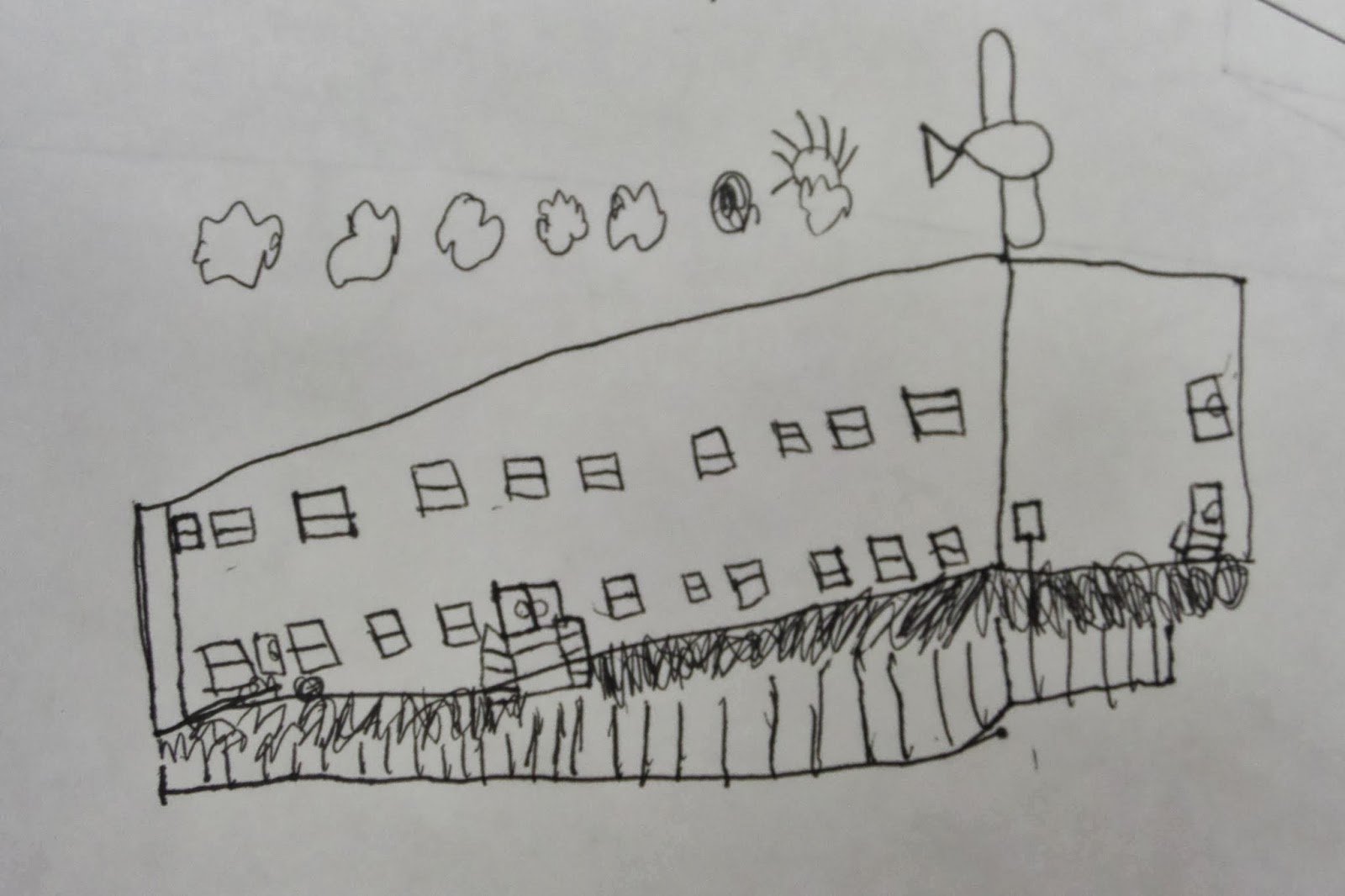
118, monolingual second grade.  Speaking of the Community project, I took a group from 118 outside to draw the school.  Since they are learning to measure using single objects in math class, I showed them how they can "measure" a subject using their pen.  The corner of the school closest to us was two and a half pen lengths tall, but the far end of the school was only one pen length tall.  By holding up their pens to measure the sizes and angles, they were able to see and attempt to capture difficult perspective. I'm really impressed with this first piece.  Take a look at it, compared to the photograph of the school.


"I know I can only draw what I see, but the airplane is flying over, so I can draw that, right?"

The photograph cuts off the top, but this student does have a good angle on the right side of the building.


101, preschool- I had the students explore color mixing for the first time using fingerpaints, like I'd done in 103. The exclamations of "look! I made green!" were exactly what I expected and we'll move onto the tempera paint exploration next.

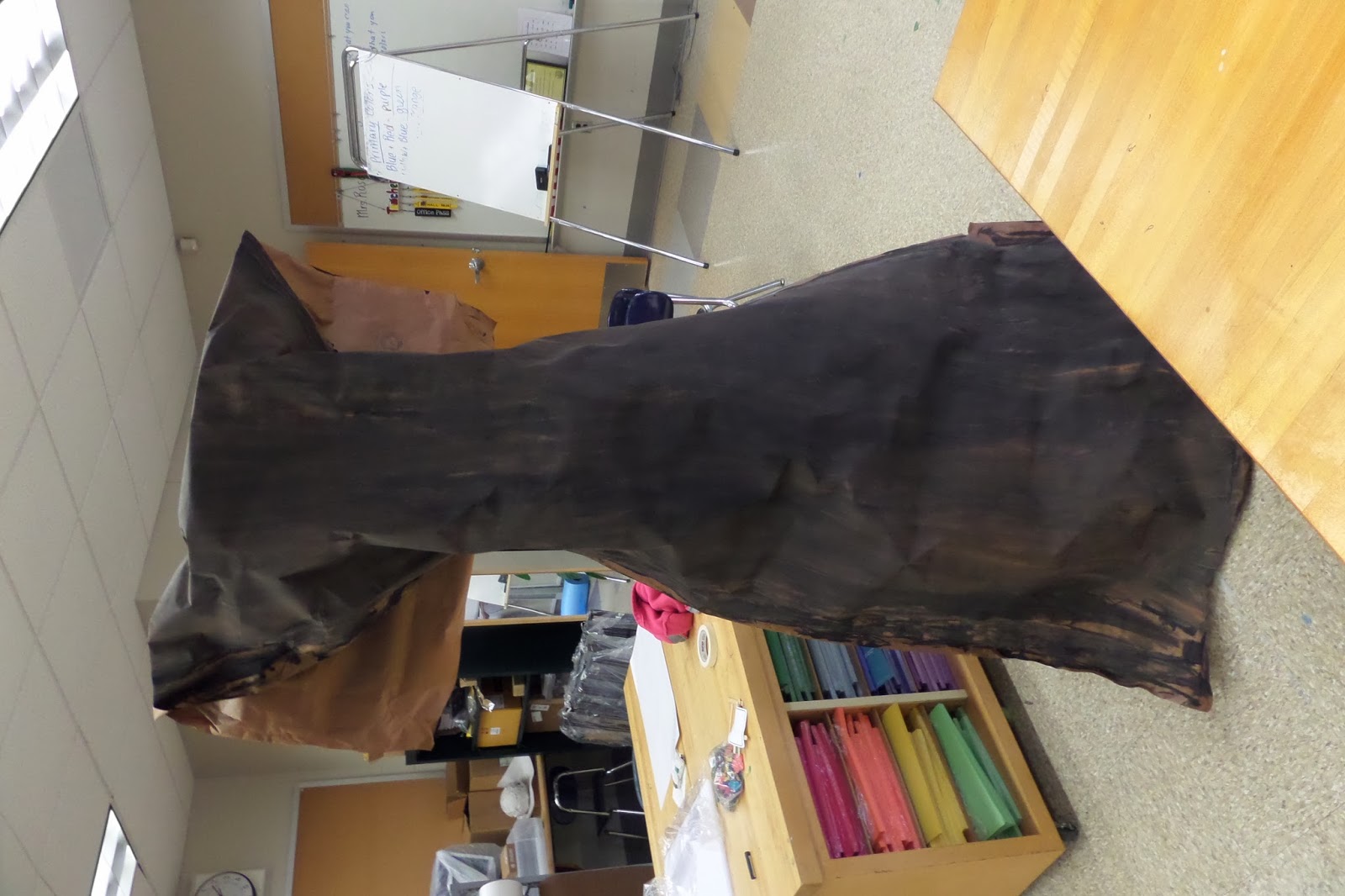
104, bilingual kindergarten. The students are really interested in nature, so they wanted to make a classroom tree.  We made the trunk out of a huge sheet of brown paper with black and multiple shades of brown lines painted on it with roller brushes, to mimic the look of bark.  

                                    
When the students came in today, I asked them about the branches. They said, "They are sticks."  I asked how we should make them, but they didn't have any ideas.  We looked at photographs of trees and saw that the branches start thick and get smaller as they branch off the original trunk.  One student said, "I think we should roll the paper to make the branches!" which is exactly what I was thinking, but I didn't want to run the show.  I asked him to demonstrate and gave him a huge piece of brown paper.  He rolled it and then asked for paint to make the bark.  He showed his friends and soon everyone was rolling and painting branches.