EspaƱol

Tuesday, September 24, 2013

Tuesday, September 24, 2013

120, bilingual first grade- We worked in small groups. The group I had discussed Austin's Butterfly and what it means to "look like a scientist". I provided a photo of each child and they drew their self-portraits again, but this time they used observation. The drawings are much closer to looking like the children and they could see the improvements for themselves by comparing the drawings side by side.

112, self- contained first grade. We continued our self-portrait backgrounds. One student  wanted to add glitter and more details to his work, even asking for supplies I hadn't presented (glitter.) I love that they don't mind going back into the work and continue to explore ideas and improve their pieces.


108, monolingual first grade- The students were learning what a "caption" is for their reading lesson.  The students drew a picture of their favorite place in our school.  They then told us what the caption should be for their drawing.  One student was drawing the kitchen area.  She asked if she could sit at a table near the kitchen to draw from observation!  Her drawing features many realistic details.  The caption makes it seem more like a story.


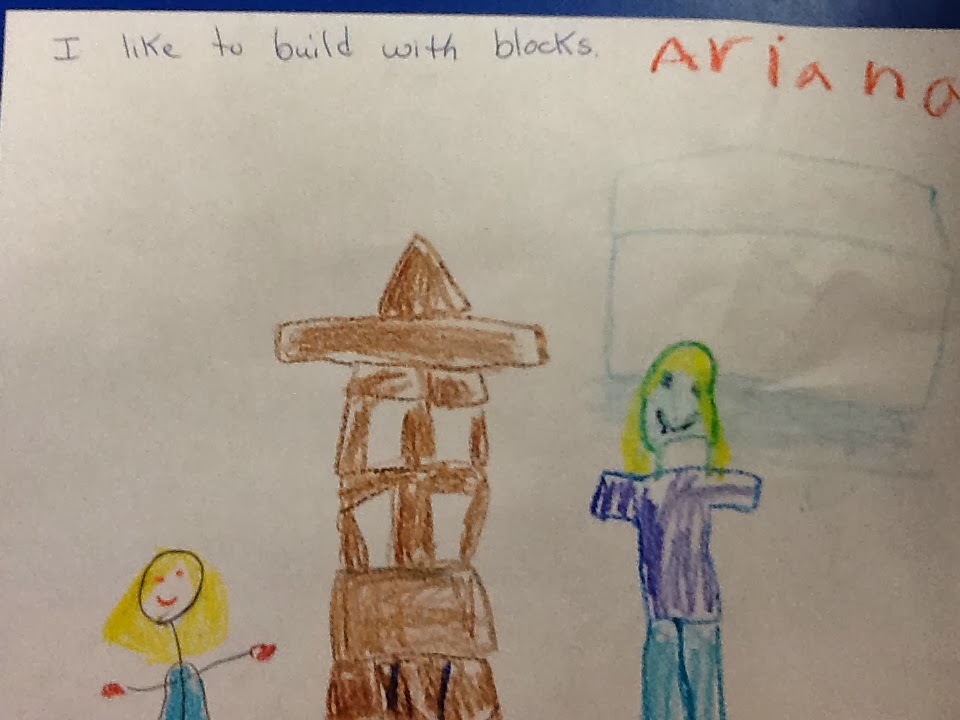
I documented about a child who made "the biggest castle ever" with her blocks a few weeks ago.  She drew a scene of herself with her castle of blocks.  The drawings are looking more realistic and I can see improvement in only a few weeks of school.

Preschool Room 101 continued with their alphabet.  

Preschool Room 103 completed half of their alphabet book. My big project for the pre-k and K over these past few weeks was to create an alphabet with each group.  I will photograph each letter on its own, so there will be four versions of each letter- 101 used foam shapes over watercolor paint, 103 used tempera paint, 102 is drawing their own letters and painting them with watercolors, and 104 created their letters out of string.  I'll place the four versions of each letter into a photo collage.  That is phase one.

For phase two, each group is going to draw a word that starts with that letter. (For example, "Egg" begins with "E".)  The bilingual kindergarten will use Spanish words, the monolingual kindergarten will use English words.  Since pre-k is dual immersion, I had to choose, so 101 will use Spanish words and 103 will use English words.  I'll photograph those four drawings and put them together in a photo collage.  

The photo collage of the four letter A's and the photo collage of the four drawings of "A" words (two words in Spanish, two words in English) will be placed side by side in a book, creating our very own School #33 English/Spanish dictionary! 

Here's a sneak peak at what Room 103 completed today! 


Monday, September 23, 2013

Monday, September 23, 2013

116, second grade bilingual- I had the pleasure of pulling small groups out of 116 to work on their portraits.  This group needed more help than the other students.  We watched the video of Austin's Butterfly and the students understood the importance of listening to constructive criticism for improvement. The drawings they created today finally accomplished what I'd set out to introduce and they will get to paint their portraits next time.

108, first grade monolingual- I was also able to pull a group of nine into the studio for an introduction to tempera paint.  I used black and white paint and let the students explore what happens when they mix, when paint drips, when brushes dry out.  They enjoyed this lesson and experiment in paint.  I taught them how to tell when they have enough paint on their brushes (the brush looks straight) and how to wipe the brushes on the side of the water cup, so that the brushes aren't too wet.

I asked the students to reflect on the experience:
Student 1 titled her work, "Rainbow". She said,  "I like to paint rainbows, even when they aren't colorful."
Student 2 said, "I love painting with black and white. I learned that I can make a zebra pattern, like my glasses.
Student 3 said, "I learned how to make the brush look straight."


102 monolingual kindergarten- I pulled half of the class into the studio to work on the next phase of their letters and lines project.  The students drew a letter, traced it with a marker and then went around it with watercolor paint.  This lesson served to reinforce the lines in letters concept and introduce the students to watercolors. We learned how to hold a brush, how to tell if the brush is too wet or too dry, and how to wash the brush between colors.

Inviting presentation reinforcing the concept of jagged lines.


Student work:


101, dual language preschool- The students were split into two groups. The children who completed an abstract line watercolor painting were in one group and the children who didn't complete one were in another group.  The first group filled the outline of a letter with foam shapes.  The second group created the watercolor paintings.  The outcome is very colorful and interesting. 


Friday, September 20, 2013

The kindergarten bilingual class (room 104) is nearly finished with their Spanish alphabet! Each student created a letter using string, in the style of Mexican string art.  The students looked at how the lines of string could be placed to create the shapes of the letters.  This will be their lowercase letter wall for the classroom. 


The Pre-K bilingual class came in for an introduction to watercolor painting.  I set the tables up invitingly. 


 We reviewed lines- horizontal, vertical, diagonal, curves, wavy lines, jagged lines, and spirals. The students used the watercolor paints to create abstract art depicting the line styles.


Some of the students are finished with phase one of our self-portrait projects in Room 112. The students were introduced to watercolor paints and created different backgrounds for their portraits. This was very exciting for the children and we started to see some fantasy backgrounds emerge.  The portraits will be attached with push pins or tape, not glue, so the backgrounds may change as often as the students would like.  The girl who told the story of the castle with ghosts during block play is going to make the castle in the background of her portrait.


Friday, September 20, 2013

Thursday, September 19, 2013

Today was a very busy day!  Not only did we have a lot going on in each classroom, we also had Open House!  It was so nice to introduce myself to the parents and show off the beautiful work our students have been producing.

I started my day in Room 120, the first grade bilingual class.  Ms. Wagner and I co-taught a lesson on critique.  We used the video, "Austin's Butterfly" featuring Ron Berger, an inquiry-based educator.  This video was shown to us by the Cadwells, our Reggio mentors, and I highly recommend it.  We watched the video with Ms. Wagner pausing to translate the information into Spanish.

After the video, I gave a lesson on how to critique.  We then looked at the students' first drafts of their portraits and the children offered advice to each other.  We'll complete a second and third draft- the third draft will coincide with a lesson on observation and the students will have their photos to observe.


Mrs. Chowaniek had the students write "burning questions" they had.  This generated some very interesting ideas for projects.  The entire pile on the right were questions about the ocean or lake.

This is a close-up of the monolingual preschool class assignment.  The students were given black paint and worked at the easels.  They painted lines and then used the back of their paintbrushes to etch lines into the wet paint.


I pushed into Room 102, the monolingual kindergarten, during center time.  I was able to record dialogue as the students created this "Tiger Zoo." One student seemed to be the mastermind behind the zoo.  When other kids tried to add animals, she informed them that the animals couldn't join.

T- What do you have here?
S1- It's a Tiger Zoo.
T-  What kinds of animals CAN join the zoo?
S1- They are all tigers.
S2- I have a rhino- can he join?
S1- No! It has to be a tiger.
S3- Or a lion!
S7- Oh!
T- So it has to be a large cat to join. How do we know if it belongs in the large cat family?
S1- It has fur!
S2- And teeth! And claws! <shows teeth and puts hands up like claws>

The students then looked for large cats until it was clean-up time.

I like the aesthetics of the zoo itself. The balance they've created with the blocks, the single male lion in front.  It's very interesting and seems ripe for a story telling experience.

Wednesday, September 18, 2013

Wednesday, September 18, 2013

I introduced watercolor paint to the students in 112.  We cut out their portraits and began a painting of a background scene.  The students were excited that they can change the background scene and move the portrait from one scene to another.


It was interesting to see the students in the monolingual kindergarten room working hard at their stations.  This pair were creating houses on the light table because "H" is the letter of the day and houses start with "H."


 This little girl created a zoo by bringing the animals over to the block area.

The bilingual kindergarten class is nearly finished with their string art alphabet.  Notice the Spanish letters are included. We are going to mount these on a different background sheet of paper and potentially laminate them if my test copy comes out successfully.

Tuesday, September 17, 2013

Tuesday, September 17, 2013

I sat with room 112 as we prepared to work with blocks. The students thought the blocks were "boring" the last time they used them, so I wanted to see if an inviting presentation would work. I arranged the blocks in a big pile on the image of a sun that is part of the rug. Ms. Natal and I sat on the rug with the students.

T is myself. S is student. More than one student will be labeled "S1" or "S2,"etc.

T- Look at this pile! What should we do with these blocks? Let's look at them first.

The students tell me about the blocks- the shapes they recognize, the colors. They decide they want to build something with the blocks, but I ask if it would be easier if we grouped them first. They thought that was a fun idea, so they identified each shape by name, asking questions about the more confusing shapes (a pyramid and cylinder were unusual to them) and quickly made piles of like-objects.

S- I'm getting the baby squares! 

The students started calling the smallest shapes "the babies".  They began to build and I said, "I can't wait to hear about the baby blocks and what stories we'll make!"

S- I'm making something to fly in the sky! 
He worked on his plane, but then decided he would make a "monster race car!" 
S- This is a race car and this is an awesome house. This part is the window of the car. 
T- Tell me about the people who own this house and car.
D- I drive the car. My mom, my sister, my dad and me live in this house. And my friend, Joseph, lives in the house, too! 

A group of students made a house together.
S1- I love to make a house. No! This is a castle! 
T- Who lives in the castle?
S2- People. 
S1- Us!
S2- Everybody here!
S1- Ms. Natal, you, me, the other kids! 
S2- Your family can live with us, too!
S1- We all have big rooms to live in!
T- That sounds like a nice community for us! 
S2- We have fun! There are ghosts in the castle!
T- I would love to see a picture of the ghosts scaring us.  Or maybe we could write a story about them!
S3 comes over, interested in what we're saying and pretends to be a ghost at the castle door.
S2-Open the door! Open the castle door!
S3- ooooooooohhhhhhh! <makes ghost noises when the "door" is opened>

The students no longer find the blocks to be "boring."

S2 drew a picture of the ghost for me.
The Castle

The "Monster Race Car"


Monday, September 16, 2013

Monday, September 16, 2013

The second grade students have been busy creating their self-portraits.  The following two images are from students in the self-contained special education classroom. We will be creating watercolor landscapes as the background and the portraits will hang next to the student interviews in their classroom. 


Some images of the students as they work on the portraits:


Room 108 created a class alphabet to hang on the wall.  They drew letters and traced them with brightly colored glue during their Reggio Inquiry block on Friday.  Today, I took a group to the studio to cut out the letters, mount them on black paper, trace the pencil lines with glue and decorate them with glitter. The photos don't really do the letters justice- they are so sparkly and beautiful in person.


Both pre-k classes met in the studio today to work on their letter walls.  The students in 101 created letters by forming lines out of modeling clay and then pressing the clay lines into the shape of the letters. There were traces of leftover glitter on the table and the glitter came off on the clay when they rolled it. This was very exciting and led to the addition of extra glitter.  The students in 103 were introduced to tempera painting and demonstrated how to hold the brush and go slowly in order to paint their letters in a very neat manner.