EspaƱol

Monday, May 11, 2015

Week of May 11-15, 2015

Monday, May 11:

Second Grade:

118 has been using a new method of documenting for Story Workshop that I want to share. We are using Google Docs. Ms. Chowaniec created a working document that lists the students' names and tracks their activities during story workshop. We add dialogue as we get it, progress, things students need to work on, successes.  This has been really easy to use and I feel like we finally have a way to connect with each other when we are in separate rooms (the atelier and the classroom, outside and the classroom, etc.)

Today (Monday) I brought a small group to the atelier to work on making their story characters out of clay. At first one student, A, couldn't tell me his story. He said "I don't know about it. Ask D." D reminded him that it's about Plants vs. Zombies, a video game that both boys play.

Who are the characters?
A- The army.
D- The plants, Spiderman and Halo.
A- Oh! I played that game!
I see you have a lot of characters that are from different games and stories. Tell me about that.
A- They are going to work together! They can teleport anywhere they want. Some people teleport and they can't get back because some evil people broke the teleporter. Spiderman teleports to zombies vs. plants, but they end up being zombies vs. Spiderman.

I reread his words to the boys and they like it. I ask if they have anything else to add, but they said they don't at this time. However, a few minutes later, I still heard them discussing the story. 

D- The plants team up and help Spiderman. Then, after all that, they help fix the teleporter and they go back to their home.

A- No! They go to the Halo world and they have to help each other and fix each other. Then they go back to the real world!


Final characters for the boys' story.

D started out with the clay working flat, like most kids do when they start using clay. He flattened the shapes on top of the paper to make the correct size. It looked fantastic, but I said, "I wonder how it would look if you made it three-dimensional, like a toy." He said he preferred it flat, so I didn't get a picture right away.  I'm so disappointed about this now, because by the time I looked back, he'd decided to make it into a 3D sculpture!
D's second attempt.

D- It's like making the story 3D when you use clay. You can make a stadium or a city out of it. If you have a lot of clay, you could do it.


Pre- K 103:

The students are moving from animal habitats into our own habitats and communities. I printed out photos of their homes and asked them to find their house as they entered. We critiqued the photographs, looking closely at the shapes, lines, colors and items from nature that we could see in the images.

We counted the windows, we looked at the location of the doors (right or left) and we looked at all of the details in the houses.


After that, the students look at the shapes of their house and, using their observation drawing skills, the students drew their houses as accurately as they could.


Pre-K drawing of a house- note the accurate placement of the
door and carefully counted windows. And I love the stairs! 

Pre-K 101:

I took a second group outside to look for letters out of twigs and sticks.

E
V

"Ch" from the Spanish alphabet! 


Tuesday, May 12th:

106:

This pre-k class has been exploring the idea of cycles. Their latest investigation focused on the life cycle of butterflies, complete with a caterpillar habitat. They watched the process, as the caterpillars have turned into butterflies over the last few weeks. Today, I brought plastacine clay into the room. It was their first time using it, so there was an excitement in the air. I have noticed that when a new material is introduced, some children need a period to just play with the material, so I was surprised by how many students immediately began demonstrating the life cycle of the butterfly with the clay. The dialogue was rich as they were creating their sculptures.

Luis- I'm making a caterpillar.
What cycle is that?
Jeysiel- the butterfly life cycle. 
Luis- first it's an egg, then a caterpillar, then a chrysalis, then it's a butterfly!
Jeysiel- I like chrysalis. 

Natalia's Caterpillar
What are you making?
Natalia- I'm making a caterpillar.
What do caterpillars do?
Natalia- they eat and eat and eat and then they turn into a chrysalis. 
And then?
Natalia- They turn into a butterfly! 
What are you adding right now?
Natalia- his legs. He has some big legs.
That's a lot of legs. How many are there? Let's count them! 
Natalia- 1,2,3,4,5,6! 
You just added one more- how many do you have now?
Natalia counts- seven! 
She repeats this process and counts eight. 
I'm going to come back to you in a few minutes to see how many legs he has then! 

I walked around the room and when I returned, she had added two more legs. She counted them to tell me that there were ten legs!


This is Shainelly's story. First, she made a caterpillar:
My caterpillar is eating leaves.


Shainelly- my caterpillar is eating leaves and he's breaking it and then he got tired and he turned into a chrysalis. Now I'm squishing it to turn it into the chrysalis. And now I'm making a butterfly! 

She twisted and smashed the clay until the caterpillar resembled a chrysalis. She added clay to the top, telling me it was the branch from which the chrysalis was hanging.


Now I'm squishing it to turn it into the chrysalis!
 At this point, Shainelly turned her chrysalis into a butterfly.


At this point, I wondered what details she would add if she took a close look at the real butterflies.

Go look at the real butterflies and see if you're missing anything. 
Shainelly- I know what I'm missing. 
What are those called?
Shainelly- I don't know!
Maybe one of our friends knows.
Devin- Antennas!!! 


Kindergarten 104:

The students have been studying insects. In the studio, we gave them many different kinds of wire, plus some washers and other metal objects, and challenged them to represent their insect using this medium.
Pedro's Stag Beetle

Zianaris' Grasshopper


The students love using the wire, even though it seems challenging at first to adjust to the new medium. Once they get past their initial struggles (It's so hard to bend! I have a hard time cutting it! I can't get the eye to stay where I want it!) the wire gives them a chance to create in a way that is unlike any other medium they've tried before.

These are starting to look like the models of insects they were referring to!

Pedro- my insect has eight legs.
Emily- no, it can't. All insects have six legs. 
Pedro- mine has eight!
Emily- those are antennas.
Jadielis and Hunter test Emily's theory and count their insect model's legs. They both get six as the number and confirm Emily's theory. 

There is a lot of counting in this lesson, as they keep checking the number of legs they need on each side, the antennas, and even the mouths on some insects! 

Second Grade 116:

I had one group finish their book together and another student just needs to add her cover. I can't wait for the students to present the book to the class (hopefully tomorrow.)  I think this is going to spark a book writing frenzy!  Since this is the bilingual class, this book is written in English and Spanish.  It's about types of plants:


Wednesday:

In Second Grade 116, the girls who completed the book were able to read the book to their classmates. They shared the steps they took to make the book. The other students were very interested and I suspect we have motivated them to want to create their own books.


Pre-K 106 continued their study of life cycles with clay. I love how easily the stories flow when students work with clay. Here is one student telling a story about a caterpillar:


Kindergarten 102 created wire insects and a spider using a page from a story they had just read as inspiration.


On Thursday, pre-k 101 and I took a walk to the Valley Nature Park Habitat Trail.  We saw a variety of living things interacting with the environment. We found a little snail on the way to the trail. We watched a kingfisher bird diving for fish in the water. This delighted and fascinated the students. Then we saw two adult geese with eleven baby geese swimming in the pond. The pond has lily pads, which Iya informed us are for frogs. We also wondered if there were crocodiles in the pond.  Lastly, we saw a butterfly that had blue on its wings, different from the butterflies we've seen previously this year.

A little snail

Running down the hill

This looks like corn to me.

Adult and baby geese!

A diving kingfisher. He was very quick, so it was difficult to get a good photo!

A blue and black butterfly.


In the afternoon, the second graders and I went to the Burchfield Penney Art Center for one last visit this year. 

Friday, May 8, 2015

Week of May 4-8, 2015

The pre-K students in 106 are studying cycles and one cycle they are investigating is the cycle of a butterfly. They have cocoons in a box in their room and today TWO butterflies hatched! The students were able to watch the one butterfly emerge.

I thought we would embrace this opportunity for dialogue, so I took a photo of the butterfly and printed out enough copies for each child to have one, about the size of a playing card. We looked at the lines, shapes and colors of the butterfly. I asked them to vividly describe the experience.  I'm wondering if we could create a book based on this exciting cycle.


What happened in your room today?
Dashaluana- A butterfly came out of the chrysalis.
Jayleen- The butterfly flied like a butterfly.
Jeysiel- It broke the chrysalis.
Reynaldo- If you move it, it breaks.

Did you see it happen?
Some raise their hands.

Why did the butterfly come out? 
Devin- So he could drink.

Anyone else have a theory about why the butterfly came out? 
Shainelly- It didn't want to stick. It did it with its tongue because it wanted a drink.

Where did the chrysalis come from? 
Jeysiel- It was a caterpillar! 

Tell me more about this cycle. So first there was a caterpillar.
Jeysiel- And then it got out of the egg.
Devin- it growed up.

What do you see when you look at the butterfly? Do you see shapes? 
Devin- It looks like a heart!
Jayleen- It's like this. [Shows me a triangle shape around the wing with her finger.]Shainelly- I see circles! 


I took 101 outside to look for the alphabet in nature. We started by looking at the book Mrs. Bennett's class made and then this group took off. They quickly found and created letters out of sticks. 


The Kindergarten students have been studying living things we find outside. They took a very long nature hike last week when I was out with the Art Department, so they wanted to share about that experience with me. They showed me drawings they did on the hike and we talked about what living things they saw. 

I had a provocation set up with rubber toy models of bugs. I placed wire and washers on the table. I showed them how the wire can bend and how you can attach wire by wrapping it tightly. The students immediately jumped into creating the insects. 


The beginning of wire insects...


The second graders have been working on books about plants and growth. The students started by brainstorming what they know about plants. It's interesting to me that the books went in different directions and how the groups worked. One group of two girls created a poster about the types of plants you'd see in Buffalo. They worked together, each girl creating a different page and checking in to see if the partner was doing a good job.  Another group of two girls created two separate books with the same theme and pages. These books show how plants grow.  The third group was interested in how we use plants and became fascinated with a video about how paper is made from trees. They are each creating separate books about this process and Ms. Ulak, our art teacher, and I plan on having them make paper themselves soon!


Thursday, April 30, 2015

Month of April 2015

This has been an extremely busy month for Bilingual Center School 33. We had a week-long break, portfolio reviews, scoring days. It went by quickly, but it was difficult to publish it all on the blog.

Pre-K has been getting artwork ready for the district art show. I assisted with some of the classes. 103 created animals, 101 made an ocean scene and 106 created a tree in Springtime.

In my room, we finished up with the lines that make up animals and started to take nature hikes to see lines outside in nature. This led to the creation of an alphabet book for 103. The students noticed that some sticks were shaped like the letter "Y" and that some sticks fell to the ground in a way that make them look like an "X". This made them wonder what other letters they could find. Soon, we were on race around the schoolyard, finding and making letters. I printed the photographs on the copier and the students used colored pencil to color only the letter. The results are pretty cool!


Kindergarten finished working on their murals and created pamphlets describing the animals who live in the biomes.


TR- What is this? 
Carlos- a beach!
Miguel- No, a habitat.
TR- What is a habitat? 
Miguel- where different animals live.

Me- This is the Savanna. La sabana. Who lives here?
Miguel- zebras
Ava- Lions
Carlos- Some kinds of deer and crocodiles? 
Miguel- Tigers?
Carlos- Rhinos! 
Ava- Birds
Angela- Bees

Me- What do you see in these photos of the Savanna? 
Angela- Grass
Miguel- Trees, mountains. Maybe that's a volcano!
Luneska- Water! 
Emmanuel- That water is a river.

Me- Did you make an animal that lives in the savanna? 
Carlos- I made a bird. It lives in the woods. 
Angela- I made an elephant. 
Me-Where does it live?
Emmanuel- In the zoo! 

We watch a video on Animals of the Savanna to see if we're correct in our knowledge of savanna animals. It mentions that elephants eat plants and vegetables.
Emmanuel- Elephants are vegetarians!

Miguel- That's a girl lion.
Me- How do you know?
Miguel- In the Lion King, it talked like a girl lion. Boy lions have this big mane.

Monday, March 23, 2015

Week of March 23-27, 2015

First Grade: I started the week with a reflection on our trips to the Burchfield Penney Art Center, the Albright Knox Art Gallery and the Burchfield Nature Center. We talked about all the places we've seen art and the people who work as experts in the field of art. The students reflected through dialogue, drawing and some writing.


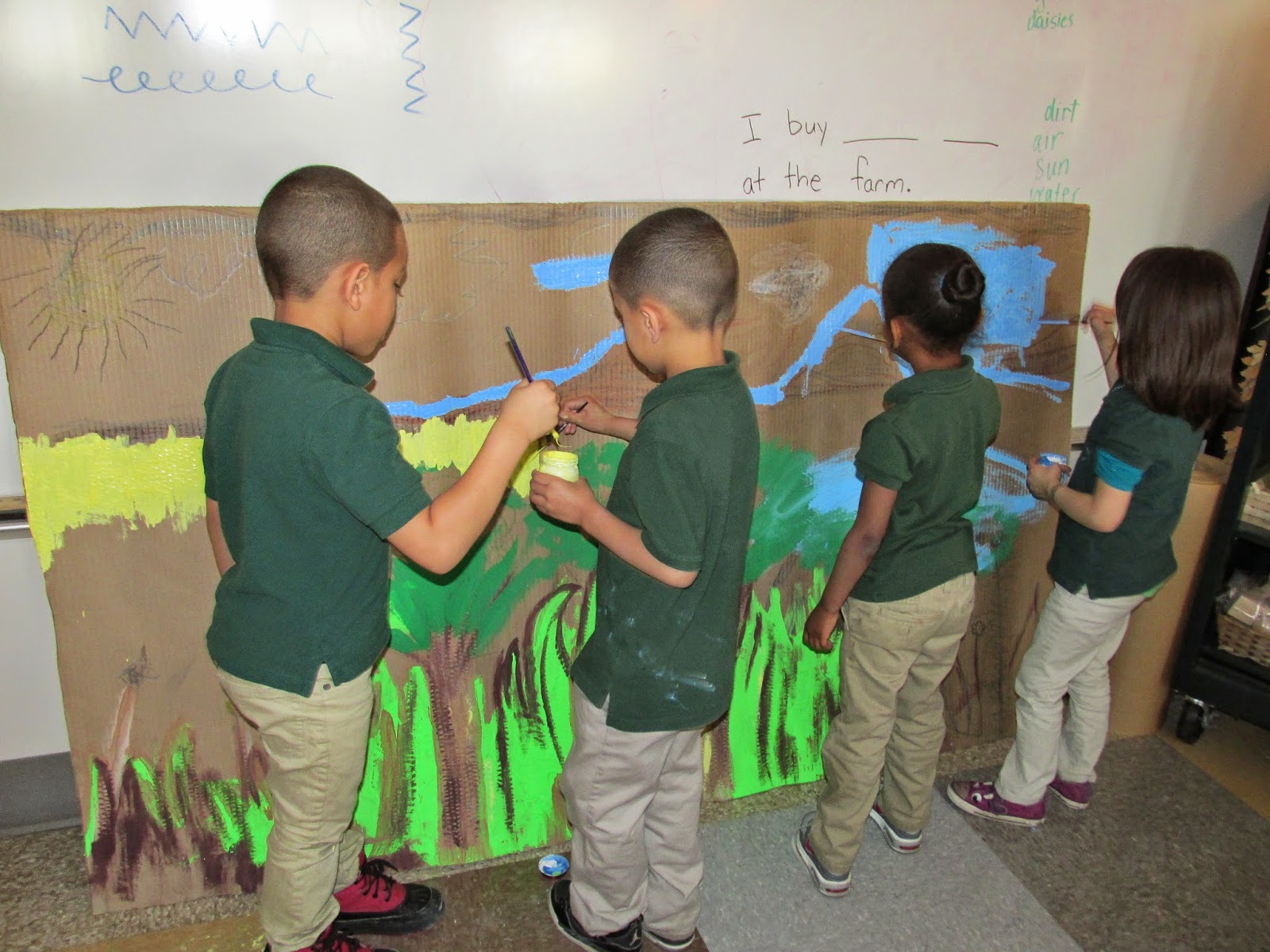
Kindergarten: I've been using open studio time for the art show and meetings, so it's been good to get back into pulling small groups for the days. I brought a group into the studio today to create a background landscape for the life-sized horse they created after their trip to the farm. I thought this would take a few days, but they knew exactly what they wanted to do and had it ready in an hour! I'd previously taught them about horizon lines, so they drew that right away and started working on the grass and sky. They knew what colors to mix from the desert lesson and went right to work.


Brookelynn to Melangell- Go up and down, not side to side. It will look more like grass that way. There you go. And be careful that you don't get it on your pants or your mom will have to get the stain out.

Teacher- So what kind of animal might live in this environment?
Brooklynn- horses, chickens, sheep
Melangell- cows. There can also be chickens coming out on the farm.
Brooklynn- what about chicks?
Melangell- chicks with their mama!
Brooklynn, singing- Chicks with their mama! Chicks with their mama! No, chicks with their dad, because the mama has to go get all of the food.
Tell me more about the food.
Brooklynn- The chicks eat worms
Melangell- what do the cows eat? Oh yeah, grass!
Brooklynn- so do horses.
Melangell- horses do eat grass, and they eat hay
Brooklynn- I know that because I went to the farm with my mama
Melangell- and I went with my dad
Brooklynn- I stayed overnight for four days. No, four weeks.
Melangell- you would miss school if you stayed for that long.
Was it summertime?
Brooklynn- yeah, but my mom didn't like it because it was kind of cold for her.

Brian joins them.
Melangell- you have to go up and down, like this.
Brian- I forgot!

Melangell- I went to a different farm.
Brian- I went to Cedar Point and I saw a zoo with tigers and zebras.
Do tigers and zebras live at the farm?
Brian- Some zebras can live at a farm.
I think you are right about that. Do tigers?
Melangell- they live at the jungle
Brooklynn- in Africa
Brian- or at African lion safari


I pulled another kindergarten group in the afternoon who'd prepared a mural about the Savannah with their teacher. We critiqued the mural and looked at photographs to see what we needed to do next. The students started painting the grass and sky. 


For second grade, I pulled a small group to continue our study of plants, as we prepare to begin a long unit on drawing and writing about plants. Two boys are very interested in the process of making paper out of trees. They watched a video about it, over and over again, pausing to read each line as it describes the process. They wanted to make a poster that explains the process, so that their friends could learn about it, too.


Pre- K continues to study the relationships between lines, pattern and animals. They reflected on the project thus far in this conversation: 

Jacob- I see my Buffalo is brown.

Eziekiel- It looks like it's melted when we draw it three times. [This is referring to using glaze three times on the ceramic pieces, and the way it looked.]

Izabella- We looked at it and we drawed it. 

Araceli- My fish has lines on the tail and that curvy line is his back and it looks like a fish and it's blue and yellow. It has lines and a curvy line going down and another curvy line on the tail. I love fishes. Sometimes fishes don't have curvy lines. Some have triangle lines. Some have "W" lines. Some have wiggly lines or lines that go down, down, down. 

Ryan- I didn't know it had a nose! Some buffalos lines look like it goes like this. [shows the outline of a buffalo with his finger.]

Eziekiel- To do the lines, I needed to see it. 

Izabella- A snake has curvy lines! 


Today, I gave the students tiny close up photographs of animal skin and fur. The students looked closely at the lines and patterns. Ezekiel is really interested in looking at the lines now. He understands the need to slow down and look closely in order to draw what he sees. 


Jacob is another student who is very interested in looking at the details. This is his drawing of the snakeskin: 


Our second graders are continuing to research and write nonfiction books about plants. These two young ladies are writing a bilingual book about how seeds grow.


Friday, March 20, 2015

Week of March 16- 20, 2015

This week:

First Grade
My second group came in to glaze their hearts.  I asked them what they think "glaze" means and Jayden replied, "Delicious?" because he was thinking of glazed doughnuts.  You could hear a pin drop during this class period- the students were so interested in how the glaze covered the fired clay.

We finished glazing all of our organs, so all that's left is to fire these and compile documentation to share the knowledge we learned about the human body when we display the sculptures! 


As each child glazed their ceramic organs, I asked them to reflect on something they know about the organ.  Here are the results:

The brain:
J'Mar- The brain is like the heart. They both help you. The brain helps you realize things.
Layla- The brain helps you be smart.
Thalish- The brain can help you think.
Remi- The brain is pink.
Jada- The brain looks like meat. An adult brain is three pounds and a kid brain is one pound.
Camron- The brain helps you think.
Ericsson- The brain looks like gum.
Tatiana- The brain is wrinkly.
Yarilys- The brain is round. 

The lungs:
Anthony- If you smoke, your lungs get black.
Miguel- When you run, you breathe a lot. Your lungs go big to little.
Hannah- The lungs help you breathe.

The heart: 
Eliseo- The heart is the size of a fist. 
Julia- The heart pumps blood through your body so it can keep you alive.
Denali- The heart pumps blood.
Shaytara- The heart beats. When you run, it beats fast and when you don't run, it beats slow.
Kiarelys- When you grow up, your hands grow and your heart grows, too. 
Jayden- We thought the heart looked like Valentine's Day, but this is what the heart really looks like.
Wilberto- The fist is the same size as your heart.
Sandieliz- The heart protects your body. If you don't have a heart, you die.
Mimi- When you are old, your heart weakens and you die.
Jangel- The heart doesn't look like a heart from Valentine's.
Elias- Your heart protects you by pumping.
Jazmira- Your heart pumps blood around your body.


Kindergarten: 
 A second small group from 102 came with me to the atelier to explore products of the farm. They said a few of the same products as the first group, but they also thought of a few new ideas.  Some of them created multiple drafts and had a book worthy drawing ready by the end of the period! I was impressed with their enthusiasm today.


We are simultaneously working on some large scale murals of the farm, the desert, the forest and the savannah. Today, a group looked at images of the desert, then, as a team, created a drawing of what their desert landscape would look like. They each drew a component. It was really remarkable to see them work together to design it. We then mixed colors and each student picked a section to work on.


Pre-K:
The pre-K students are still looking at the lines we see in animals. This lesson is really helping them grasp observational drawing. I've got centers going on in the studio. Students drew a pre-drawing, then traced their animals on acetate to see the lines. After that, the students are trying to draw the animal again from close observation of the photograph. Slowly, one or two students at a time are breaking through and learning to see the lines and draw them on paper. Once they've accomplished the line drawing, they work with plasticine clay to try to sculpt their animal. After the plasticine, they are creating the animals in firing clay. The last step will be to glaze the clay. 


Second Grade:

After seeing how much the students are interested in storytelling, we've decided that the atelier will support Story Workshop in helping students create strong illustrations to go with their stories. For 116, we are working on stories about plants, a subject they are very interested in lately. We've decided to start by writing down as much as we know about plants.  Some students were curious about the paper making process, others want to show how plants grow, while others were interested in learning and sharing about the many varieties of plants.


For 118, I worked with students on illustrations for their different stories. One boy is working on a comic book character named Piranha Man for his story workshop. I helped him shape his character by asking open ended questions. The other three boys wanted to create a book about animals. We looked at fantasy and nature books about animals and they decided that they wanted to make a nonfiction text about them, with observational drawings and facts.


Wednesday, March 11, 2015

Week of March 9-13, 2015

I spent three days last week at Skillful Teacher training, which was really interesting and enjoyable. I already tried one of the techniques I learned (Popcorn discussions) to ensure every kid in my last group today was able to share out their experience about a field trip they went on. They were excited to try something new in our discussions, not that they don't love to talk anyway.

Here is a rundown of what everyone is working on: 

Pre-K- Mrs. Bennett, Ms. Hernandez, Dr. Lopez:
The pre-k students have been working on drawings of the lines we see in animals. They started with pre-drawings, moved to tracing the lines on acetate paper, then created a post-drawing to see if they could see the lines better after the tracing let them recognize the lines. We used vocabulary like vertical, horizontal, diagonal and curvy to understand that the lines we drew alone are used to draw anything in the world!


From the drawings, we are moving into two types of clay. Plasticine for practice, then firing clay for a final product. 


After this lesson, we are going to look at the patterns we see in animals, so I'm going to set up a provocation with photos of the details of animals with patterns and we will paint or draw those patterns. 


Kindergarten:
104: The kindergarten students are also working on recognizing lines to build their observational drawing skills. We are comparing fantasy paintings of animals from an Eric Carle book to scientific drawings of animals from a book on wildlife artists. 
102: The other kindergarten is also using lines to draw, but their focus is on the products we get from the farm. They will use observational drawing techniques to draw things like wheat, dairy products and fruits and vegetables. 


First Grade: 
The first grade is finishing up the sculpting part of their models of human organs. Our last group will finish today- Wednesday- and then I'll begin the cycle of groups into the studio again to glaze their organs. 

Today, Wednesday, I had a group come in to create their brain models. I'd used our previous example of a one pound object (plasticine clay in a sealed package) so I found that our wood glue comes in one pound bottles. We explored what three pounds might feel like, which is the size of an adult brain and I explained the concept of one-half, which is the size of a baby brain. This group made the same conclusion that the other group had, that a child's brain is probably one glue bottle in weight, or a pound. I thought that was interesting, that both groups were able to take those two facts- an adult brain size and a baby brain size and reason that they were closer to the baby than the adult. They measured their clay compared to the weight of the glue bottle and sculpted their brains.


Second Grade: 
The second graders were on a field trip to Reinstein Woods. When they returned, I only had a short amount of time to spend with 118, so I asked them some questions about the trip. The first provocation was Tell me the story of your day. The second was Tell me something you experienced with your senses on the trip. The third was What did you learn about today? And the fourth question was How would you share this experience with the school? The students used the popcorn method of answering then selecting a friend to make sure that everyone had a chance to share out about their day.

I pushed into 116 to work on the provocation, "How does it grow?" I sat at a table with that provocation written out, a jar of pens and some paper, with two of the plants they are growing. I waited and soon I'd acquired a small group of curious students.

How does it grow? 
Jose:You need a seed.
How do you get a seed? 
Jose: From other plants. When a plant dies, the seed falls and then it can become a plant again when it dies.
Yabdiel: Seeds and water. 
How does water work to make things grow? 
Jose: they suck it up, like a straw. 

Eliani: You need food. It keeps you strong and healthy and when it's your birthday you grow. 
How does your birthday make you grow? 
Jose: cause you change age.
Do you look bigger the day after your birthday? 
Eliani: Not right away.
Jose: when you grow for a while, clothes don't fit you. I have clothes i brought with me from Cuba and they don't fit me now.
Eliani: I had clothes from when I turned six and then I turned seven and I put on one of the clothes and it didn't fit me. The shirt was too short.

Can you feel it when you grow?
Eliani: no. I can't. I'm thinking if the babies feel it when they grow.
Jose: I'm not sure. My sister got shots on her over here.
Eliani: my brother can feel his leg growing. He's crying at night because it's stretching out, like how a snake is in a circle. 
Jose: when I pick my sister up, she is heavier every day.

How can we help things grow? 
Eliani: when we put water, some of the plants grow. My mom had these seeds she didn't know and they grow seeds that we can start eating, but we have to cook it. She bought all of these seeds, but we never used them and someone threw them out.

Jose Writes time water sun and ere.

How can clay grow? 
Eliani: clay can't grow, but if we mix clay together, we can pretend it's growing. 
Natalia: if we give it water, it might grow.

What if something grows too big?
Jose: whoa! A tree!
What happens if a tree grows too big? 
Jose: if a tree gets too big, it dies.
Eliani: if it grows too big and the wind is coming, it falls.
Jose: sometimes if a tree is dead, parts of it fall off and little animals come and live inside of it. How do you call that bird that eats the side? A woodpecker. He comes and eats the side and then he gives it to his babies and the babies grow!

So trees can help woodpeckers grow? 
Jose: yes, because they can find food in there. In the trees. And they can put their nest in there. 


Eliani: One time my stepdad's sister found out she had a little tiny baby in her stomach so she kept eating and the baby got bigger and bigger and then they took it out and now it's like a regular baby. It's a boy.

We had a lot of snow piles growing this year. How did that happen? 
Jose: the snow falls and goes into the pile and makes it bigger.
Eliani: and when the people move the piles, they push them and the piles get bigger.

Eliani describes her drawing and mentions watering the plant over and over.
I wonder if you could design a growing machine and then we wouldn't have to remember to water the plants.
Jose: like a robot!? 
Nelson: wow! Yes! That would be awesome.

They eagerly draw robots to take care of their plants. 

At the end of the class, a student showed me a stuffed toy he had in his backpack (it was dismissal at this point.) I told him I would love to read a story about this character he called, "Anger Man." He took paper to write a book for me over the weekend. Three or four other students then showed interest in writing a book, so I offered them paper. I'm hoping this will spark an interest in storybook writing!