EspaƱol

Tuesday, February 25, 2014

Tuesday, February 25, 2014

Today was the first day of our partnership with the Burchfield-Penney Art Center.  The Burchfield-Penney is a local art gallery that features a similar philosophy involving open-ended questions, a focus on calming aesthetics and ties to nature.
http://www.burchfieldpenney.org/

Our partnership will run through May.  The students in grades pre-k through second grade will visit the Burchfield-Penney Art Center three times. They will have a docent visit their classrooms at School #33. The final visit will also feature a trip to the Albright-Knox Art Gallery, which is located across the street.

The students will be given time to draw and create art in the Art Center.  At the school, we will be reading excerpts of Burchfield's journals.  Burchfield lived in Buffalo and often took walks.  On his walks, he recorded what his senses felt. The students will have a chance to do that.  They will collect treasures they find (twigs, leaves, etc.) They will sketch outside.  They will photograph what they see.  From the photographs, they will create observational drawings and eventually watercolor paintings.  The students will be given journals and they will use the journals to record their experiences through the languages of art and the written word.


120- Esmeralda and N came in and painted their beautiful bridge.


116- I brought posters from the Burchfield-Penney into Room 116. They voted on the one they wanted to keep in their room. I was going to take a group to work on the balance project, but the students were really interested in the painting, so Mrs. Driscoll let me push in and direct an art critique!  We went through the four steps of art criticism, which falls under "text-based answers," one of the Common Core Standards for ELA in technical subject areas.  Some of the students really understood the benefits of looking closely at an artwork- a few mentioned that our critique made them change their minds from initially not liking it to appreciating it. 

At this point in the day, the Pre-K and I went to the Burchfield-Penney! 

"We're going to the future!" (One student kept saying "future" instead of "field trip.")

Sitting like the painting.

Developing new vocabulary words with a docent.

Seeing the recreated studio of Charles Burchfield.

This room had water flowing down the walls which matched the activity in the room. 

Sketching in their jounrals.

Learning about the installation.

"Mrs. Rose!  Look what I made!" 

Painting wet on wet. 

A beautiful artwork.

"We're drawing our shadows!"

The Burchfield has beautiful spaces.

Looking down from the second floor.

"I wish I could jump down to there!" One child said.

Daniel couldn't stop sketching. He was intrigued.

Making artwork.

Beautiful painting.

Very excited students!


112- Ms. Natal and I decided that we would take the study of the ocean to a different place.  "What is under the ocean, but shouldn't be there?" was the new question.  The students made a list of things that belong under the water and things that do not belong.  This was a stretch at first, but eventually they started picking up on the idea that human litter, shipwrecks, and "treasure" end up under the water.  I showed them this image from the Burchfield-Penney to inspire them and asked them to look for it on their field trip! :)


103- We reviewed our field trip experiences. The students made drawings with fine-tipped pens and then painted them with watercolor paints. I will post them later. 

104- My student teacher and I worked with small groups on observational drawings again, focusing on students who were struggling.to understand.  We made a few breakthroughs, most notably Marianys.  She was drawing a ladybug and her first six or so drafts were symbolic of what a ladybug looks like to her.  I showed her how to break the parts of the bug down into shapes.  She immediately drew the bug more realistically and then she noticed that my one table looks like the ladybug's closed wing!  She was so excited.  She circled the table, feeling the edge, then showed me it on the paper.  


Monday, February 24, 2014

Monday, February 24, 2014

120- We brought students in to work on building bridges. Esmeralda and N made a really interesting model for a covered bridge.


118- I brought students to the studio to create their rolled paper sculptures.  The students and I had a conversation on working collaboratively.  I wanted to know if they noticed the difference that I've seen in this building- that students are seeing each other as assets and useful collaborators. They feel that school is better this year because there are so many projects that allow for group work.  

Gabriella- We feel happy and proud of ourselves that we can work together. 
Patty Ann- There are a lot of nice things you can do when you work together. We can listen to each other and it feels good to be nice to each other. 
Gabriella- I like our school because we can have fun while playing in our groups, but we can also learn in them. There's learning things in our groups- we learn lots of stuff, like science and social studies.

I think I'm going to ask some other classes how they feel.  It was nice to get feedback and I think it's good for the students to reflect on the fact that they enjoy being a part of our school. 

101- The students finished using the sorted beautiful materials to write their names.

103- The students worked on their houses again. 


Friday, February 14, 2014

Friday, February 14, 2014

Today is a different kind of day, as it's Valentine's Day and many of the classes are celebrating!

120- We had an Honors Assembly during this class. I am very proud of all of the students who are growing and achieving, both academically and behaviorally.

116- We pulled the last group of students to begin the symmetry lesson.  This group happens to be a group who needed more instruction on their math lesson last time.  Something I noticed between the last group and this group is that the students who are excelling at math were able to demonstrate symmetry without any problems.  They aren't necessarily the strongest artists I teach, but with this lesson, it didn't matter at all! They knocked this out of the ballpark, so to speak. :)  With the group I had today- the students who needed extra help with math- this was a struggle for the most part and some of these students are really strong artists!  We know that symmetry and math go hand-in-hand, but it was really obvious in this comparison.  I will remix the groups so that some who are stronger at math will work with those who struggle and the children can teach each other about symmetry.

108- We had the fire alarms go off during this class and the students had to .  Some of the teachers were able to quickly grab coats (myself included, as I leave it on my chair) and as we waited for instructions, I saw that the teachers, myself included, wrapped our coats around as many kids as we could, huddling close to them and joking with them to keep them calm. (I told them, "It's Valentine's Day, feel free to hug your friends for warmth!")  We had no idea how long we would be out there, or if there was a real emergency, and it's about 25 degrees outside, but our first priority was to keep the kids comfortable and that speaks volumes about the level of commitment of the teachers of School #33.  Fortunately, this only lasted a few minutes and it was a false alarm. Our local fire department and administration handled the situation quickly!

We came back inside and the students did their daily exercise to warm them up.  This is usually done at a different time, so it ended up using up some of my time in the classroom.  Instead of pulling students out, I pushed in and worked at the playdough center. The students made cookies and charged other students invisible money to "eat" the cookies.  I demonstrated ways to smooth out the dough and make it even for the cookie cutters, then asked them to take it a step further and "decorate" the cookies.

118- I brought a group in to work on symmetry.  This group was outstanding.  Everyone understood by the end of the class and they did a fantastic job.

101 had a Valentine's day party.

102 also had a Valentine's day party.


Thursday, February 13, 2014

Thursday, February 13, 2014

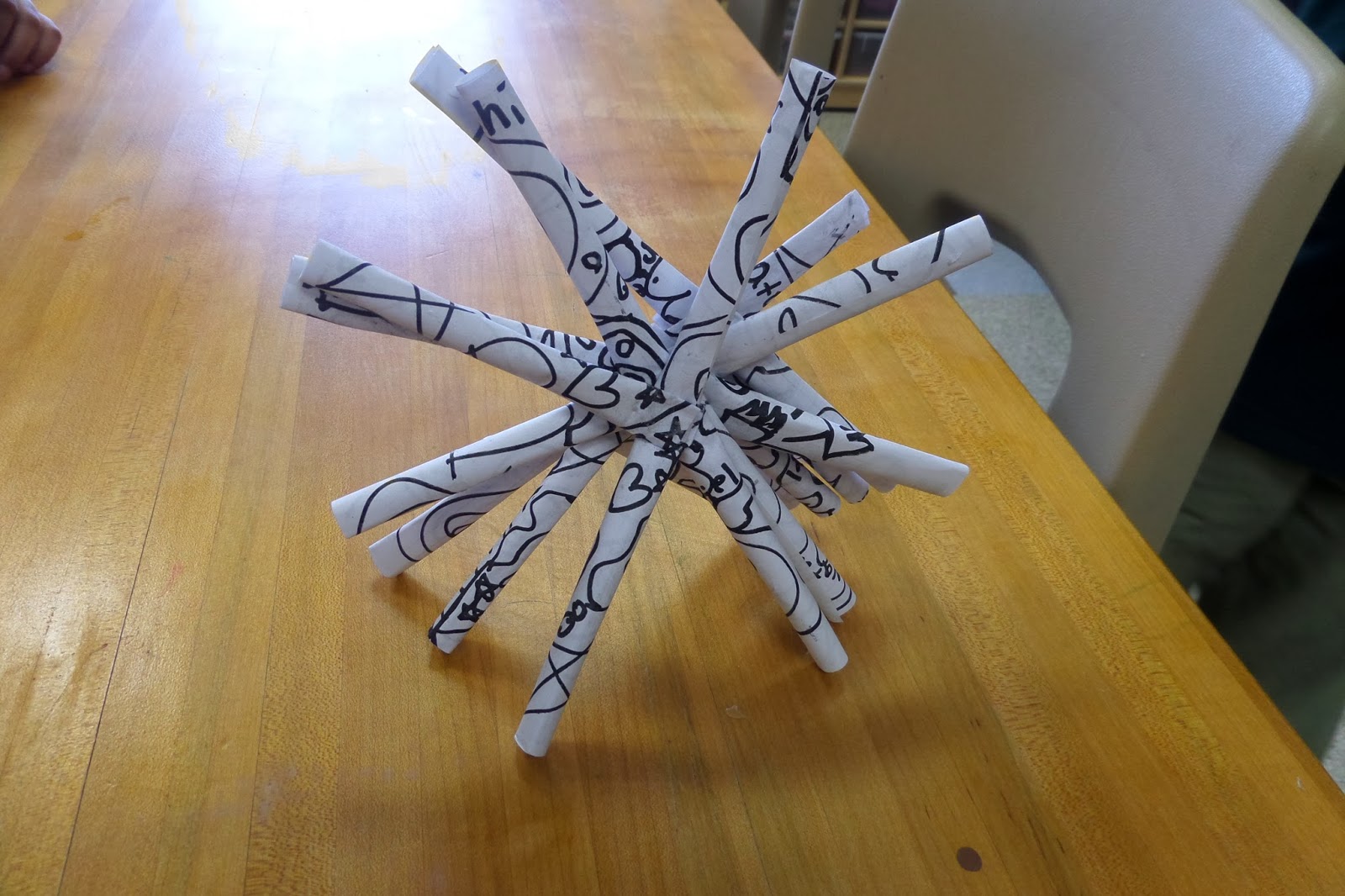
116- We brought group one in to finish their asymmetric paper sculptures.  We critiqued Nancy Rubins' sculpture at the Albright-Knox Art Gallery.


I recorded this dialogue about the Nancy Rubins' piece:
 Yair- I've seen that!
Jornand- Me, too!
Teacher- What is this?
Jornand- it's boats!
Teacher- It is boats! It's canoes. Do you think we could make something like this?
Jornand- No. We'd need ropes.
Nataniel- And these things.
Jornand- These are wires. And a truck to move the boats.
Teacher- I wonder if we could make a sculpture that is like the Nancy Rubins sculpture, but uses our paper rolls instead.
They all agree that we can definitely do that.


 They begin to build and they really get into it.  Everyone seems pretty excited as the sculptures take on forms of their own.

Yair makes what Isaac calls a three-legged giraffe.
Isaac- Mine is balanced!
Gloriana has created a sculpture that looks like a horse.
Luis says that her sculpture looks like a big gun, but others disagree.

Daniel- it looks like wood. Or a ball machine. The ball is in here and comes out here.

Issac- mine looks like an airplane. Yours looks like an animal.
Jornand- A zebra.

Glorian-  I think mine looks like a dog.

Jornand- It's not balancing no more.
Issac- Because you took it apart.
Daniel- it's not balancing because it had nothing standing down.

Gloriana finishes hers and offers to help Justyn, who was absent on the first day and slightly behind the others.

Issac- Tomorrow, we get candy.
Jornand, sings- Candy, Candy, Balancing, Balancing

Daniel takes the envelope we were using to store the pieces and decides to add that to his sculpture.

Issac- Luis' sculpture looks like a spider that was putting the legs down.
He makes a gesture with his hands like spider legs.


118- We had another group of students come in to do the "What is Balance?" provocation. They were really silly and funny today. 

"It's a sad Cyclops!"

We can balance our mustaches under our noses!

G created this and said, "It's showing balance because the side that's up
has nothing on it and the side that's down has two beads."

A's work


108- I brought the students in who are working on the habitats.
Our beautiful watercolors in progress.


112- The group came in and worked on designing bridges with wood. 


101- The students needed practice with sorting, so we sorted beautiful stuff.  I asked them to sort it and they chose to sort by color.  They will now use one color per letter and write their names with the pieces.


104- The other half of the class worked with my student teacher on drawing animals that hibernate.  These will be used to decorate the bear cave they made, like cave art. 

Tuesday, February 11, 2014

Monday, February 10, 2014

120- We took a small group to the studio to see if they could build a bridge with art materials, after doing this provocation in the block area of their room.  I had two groups of two students each.  One group made a successful bridge and the other group might be successful with a bit more time.  They were heading in the right direction at the end, but didn't fully see it through.

116- I took group one into the studio to start the asymmetric balance part of the three-part balance provocation with me.  They've already created something with balance out of beautiful stuff and drawn a symmetric design.  I made copies of their symmetric drawings and cut them down into small squares. The students rolled the squares and glued the ends, creating paper tubes that they will use to assemble into a collage tomorrow. The collage will be inspired by the work of Nancy Rubins. The students will have to use their knowledge of balance to successfully assemble the collage.


108- I continued to work in small groups on observational drawings of animal habitats. The students are given a choice of materials to use, so they can practice working in a medium that they are comfortable with, or want to learn more about.

112- I've noticed that this group, like 120, has cars in their block area. I pushed in and documented this block play. The students are trying to build a bridge in the block area, a provocation that they will continue in the atelier. J and E immediately begin to build a bridge.
Teacher- How will the car get onto the bridge.
S- It will jump and go like this.
He makes the car jump about two feet in the air and fly to the other side.
Teacher- I've never seen a car do that in real life. Do you think cars can really jump like that.
J says no and hands us the ramp block.
J- You use this and the car can go up.
E and J begin to collaboratively build a great bridge. They test their bridge by rolling a toy car across it. The bridge lacks a ramp on the other side and the cars just tumble off. J adds a second ramp. Now the cars roll across easily. They played with their bridge for the rest of the time I observed. I can't wait to take them into the atelier to create their own bridges.

M was working with play dough.  She came over to show me she built a bridge with it!


We also found a block that is round with a flat edge. We played a game to see how many blocks could be balanced on it. It was really fun and E was better than I am!


103- I printed out photos of their houses and the students compared the previous block creations they'd made for their houses with the photographs. They were given a chance to return, switch out or add more blocks to their house creations. Then they counted the windows and drew them where they belong and drew the doors, too.

104- A small group came in to paint the bear cave.


Monday, February 10, 2014

Friday, February 7, 2014

I wasn't here on Friday, but my student teacher was.  He took documentation and photographs so I wouldn't miss anything!

The students had a presentation from a wildlife rehabilitation center.


108 continued their observational drawings.  This student was struggling to see the lines and shapes he drew as the real scene, so my student teacher used the child's drawing to make a map to help him understand the lines.


Dialogue from my student teacher:

J- Sir, Mr. These clouds don't look right. I need help.
Teacher- Well, look at them closely. Do they go this way? [vertically]
J- No, they go this way. [indicates horizontally]
Teacher- Good. So you really have to look at the picture to see what they really look like.
J- Well, they're not exactly white.
Teacher- No, they're not. What are they?
J- I need blues and also this gray.
Teacher- Exactly. See, I told you when you look you find more.  You have to layer.


112 continued to build bridges.

David- I want to build a bridge. It has to go over water so I don't fall in.


103 critiqued the Spring Mural. Here is a funny clip of dialogue demonstrating that the lesson taught the order of the color wheel and rainbows through the little chant we did.  Brookelynn, one of the pre-k students, unprompted, led the chant in my absence- how amazing is that?!?

Brookelynn- Red, orange, yellow!
Students- Red, orange, yellow!
Brookelynn- Green, blue... PURPLE!
Students- Green, blue... PURPLE!
Brookelynn- That's a rainbow. Red, orange, yellow, green, blue, purple!

Then she started to draw a rainbow.