118- I've set up a provocation, "What is Balance?" in the
atelier. This is the same provocation
they've been using in the block area of their classroom. The supplies I've laid
out are wood beads, dowels, Popsicle sticks, feathers, pipe cleaners, pens and paper.
Right away the students grab materials and start doing what they
think I expect.
J- Here, Mrs. Rose! I'm done!
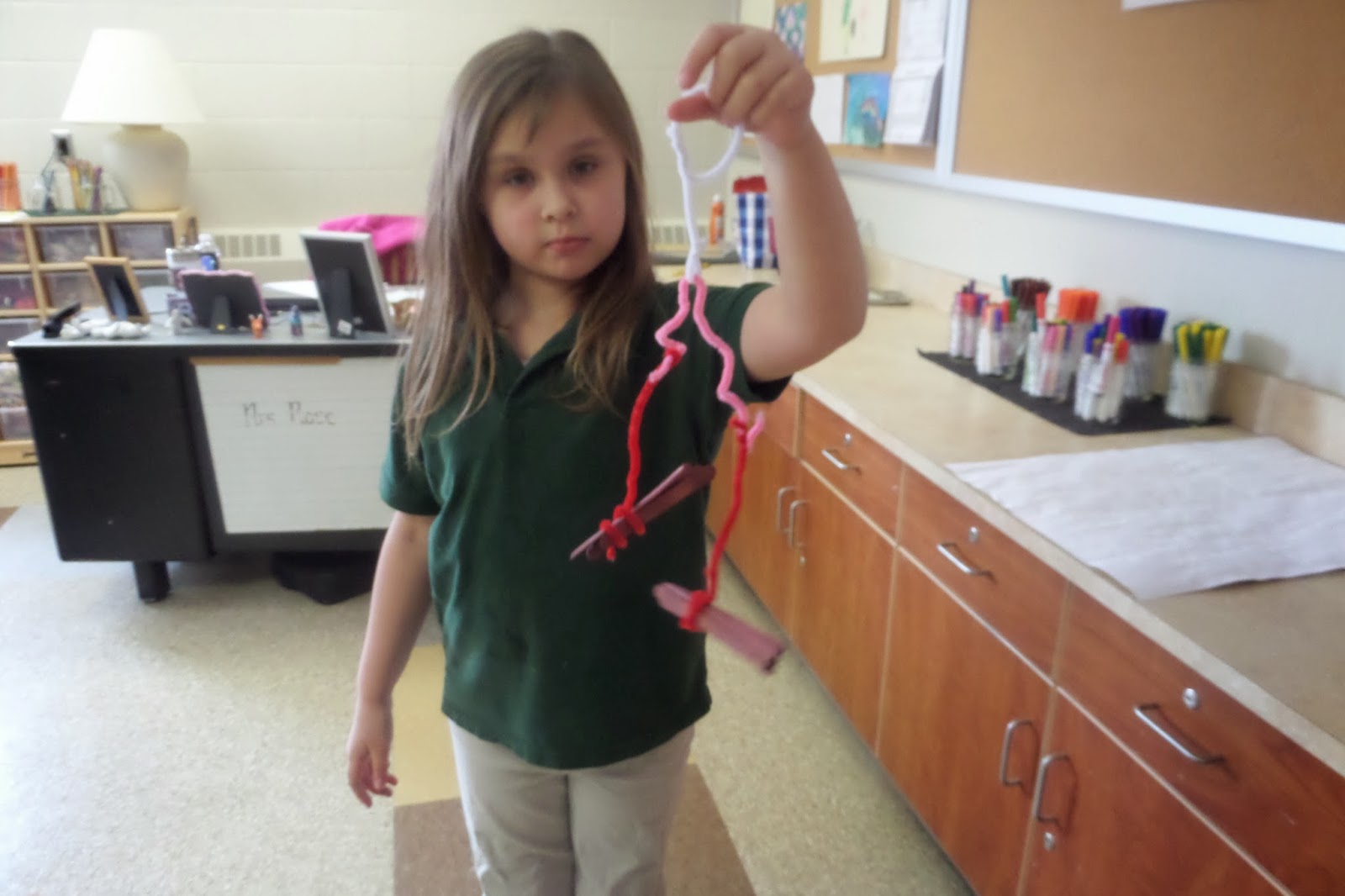
She shows me a pipe cleaner sculpture that looks like a ramp to
me.
I explain that we have a half-hour to explore and I want them to
dig a little deeper in their creative process.
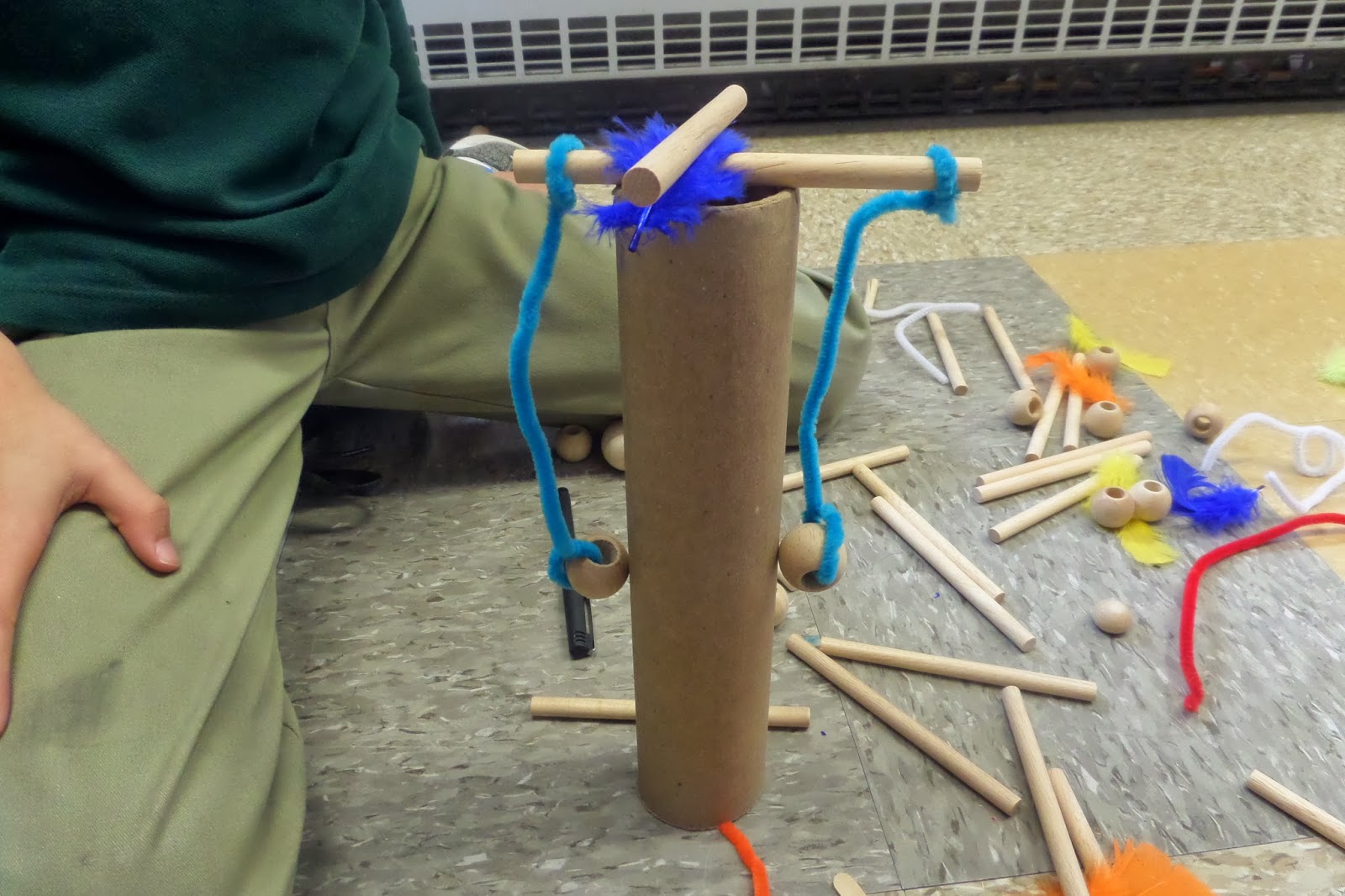
R and E are busy creating. E is clearly trying to show balance.
He has wooded beads on pipe cleaners and the materials he's choosing are chosen
in pairs. I can tell he's thinking about symmetry.
J now is creating something else. It looks like she was
influenced by E.
C drew a scale and then said she was done. I asked her if she
could now create balance with the supplies. She seemed reluctant at first, but
the. She started working with the pipe cleaners and beads, just like E and R. I
wonder if I should have the students take their supplies to other parts of the
room so they aren't just copying each other.
I remind them that their focus is on demonstrating what balance
is. S wants me to tie something for her, but I remind her that this is her
investigation and I want her to really be creative with how she works.
C understands balance as a scale. I've seen her draw scales for
both this investigation and in her classroom,
yet for the building process, she is copying her friends. I tell her
that I know she understands balance on paper and I really would like to see her
share this knowledge through the materials. She goes back to the supplies and
tries again.
E- balance means heavy or not heavy. Man, this is hard. Balance means how much it weighs.
I love that I was able to go back to their teacher and say, "I can tell you this kid, that kid, and this kid really understand balance. These two still need help..." This was an assessment of their understanding, based on the research they've been doing in their classroom with the block provocation and it was very easy for me to assess them based on visual and spoken language! I felt great about that. We can tell if the material is understood based on their reaction to provocations and experiences, without taking a paper assessment. Really great start to a really productive day!


112- Two students finished their ocean habitats. I drew their collages and the girls told me what each piece represented and I labeled them, rather than labeling them on the students' work. I was happy to see that they were thinking about the needs of their underwater creatures- food, reproduction, the ocean floor, other creatures were all represented and once we delved into what they'd created, they made their thinking visible.
Ms. M- Why does it need a plant?
A- He needs to eat.
She added a fish.
Ms. M- What happened to the fish's food?
A- He ate it all. He needs to find more.
Then she added buttons to represent more fish to eat.
 |
| Description of the Killer Whale Habitat |
 |
| The Killer Whale Habitat |
 |
| Description of the Electric Eel Habitat |
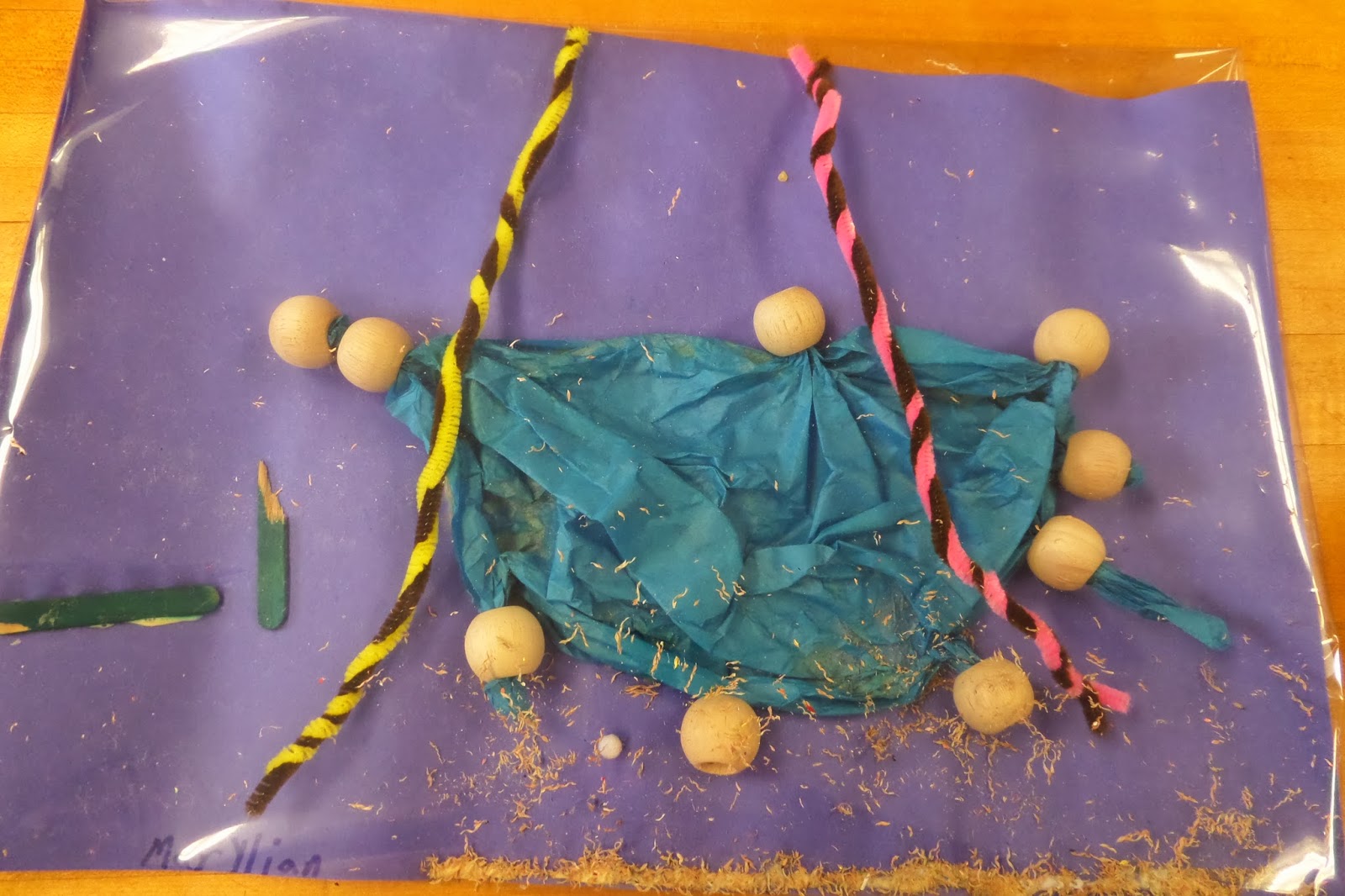 |
| The electric eel habitat |
116-
What is balance provocation with 116
This group comes in with the same start as 118. One creative
person demonstrated balance with the wooden beads and a dowel and then all five
others copied. They all looked at me with big smiles and said, "We're
done!"
I challenged them to go back in and create one that isn't the
same as anyone else. L and J were quick to create unique, balanced sculptures.
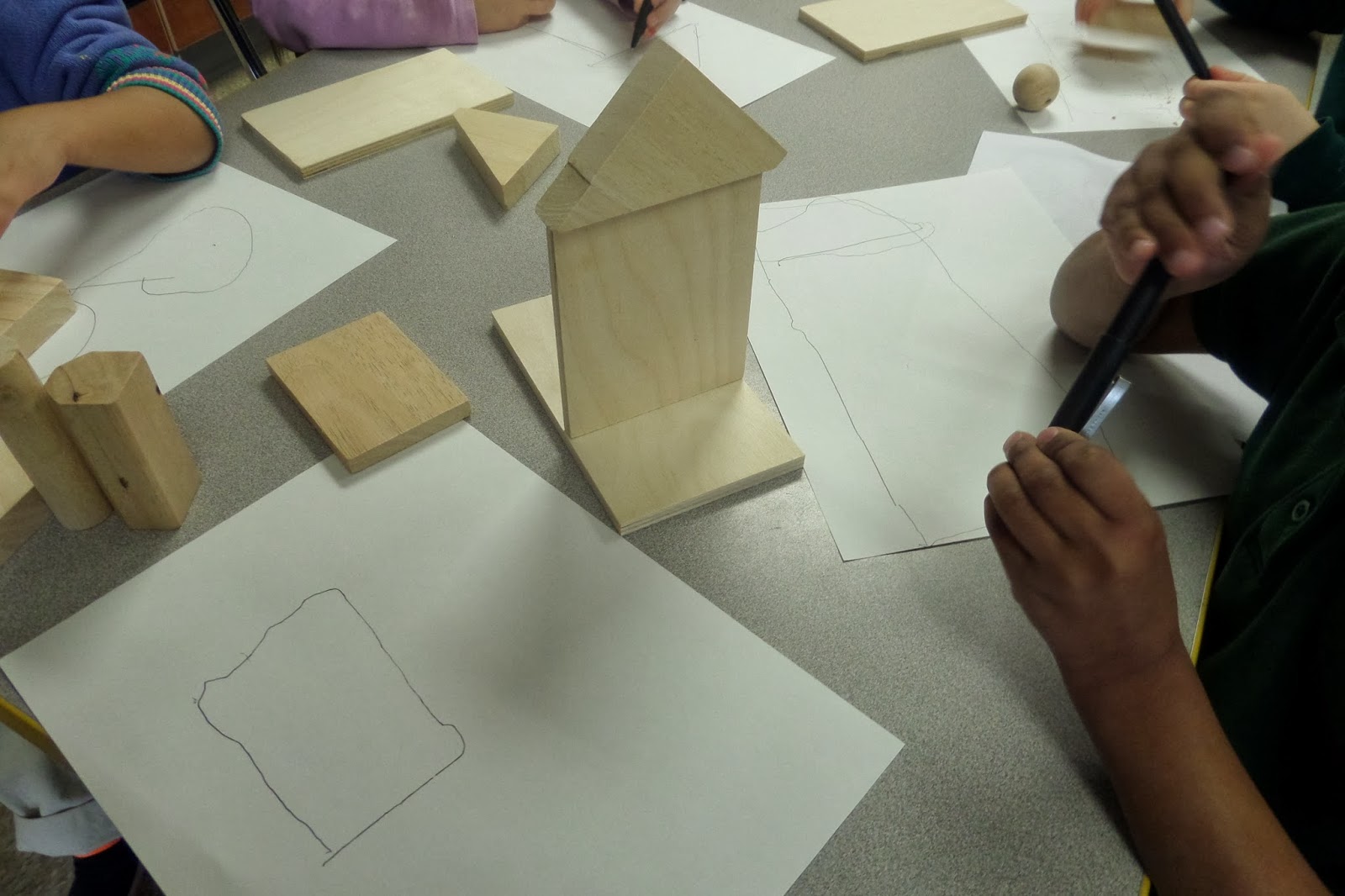
J takes his to a table and begins to draw it out. He tries to
stand it up, but it won't stay.
Mrs. Rose- I wonder how you could get that to stay...
He continues drawing, but I hope that he will attempt to add
materials to make it stand.
L now has a similar, yet not exact, sculpture. He realizes that
it isn't symmetric and therefore does not balance, so he adds more to the
missing side.
A shows me her sculpture. It has symmetry and a dangling piece
that is balancing in the center. She hits the piece and it's similar to a
teeter-totter.
J's drawing is impressive. He gets observational drawing now and
aha quite the tool for his investigations. I'm proud of his progress since the
beginning of the year, in behavior, leadership skills and artistic ability.
S and J2 are still building while the boys and A are busy drawing
and writing. L is excited to show me his piece.
S finishes and has dangling pieces and perfect symmetry.
I love that this simple investigation is able to show so much
about their knowledge of balance. By using spoken language, the language of
art, and written language, we've created an assessment that is so much more
meaningful than answering test questions. This philosophy continues to amaze
me.
 |
| S's drawing and sculpture |
 |
| J2's sculpture |
 |
| S's sculpture |
 |
| L2's sculpture |
 |
| L's sculpture and detailed drawing |
 |
| J's drawing |
 |
| A showing me the teeter-totter concept of her sculpture |
 |
| Another view of J's drawing |
120- I worked with two students at the block area with the current provocation.
Teacher- We need to cross from here to here. How can we do that?
E- I know! We need a boat!
Teacher- But what if I need to get my car across?
N- If the helicopter goes from here to here, it can take the
car.
E- I don't know if that would work. Maybe the boat can take
the car.
Teacher- That is a real thing.
I show her images of ferries carrying cars.
E- I saw a movie once where a boat was pulled by a car and
the girl pretended she was driving the boat.
N- We could take the car here, to New York City.
He is referring the blocks set out for the provocation as a
cityscape on the other side of the river.
Teacher- Have you ever been to Canada?
N- No.
Teacher- Did you ever drive by the river? You can get to Canada
if you drive by the river. You just have to go on one of those... What are
those called again? Those things you can drive over?
N thinks about it and gets my clue- A bridge!
Teacher- Oh, that's the word. I wonder if we could build a bridge
here, with blocks!
They are excited to try this.
Nelson sets up a ramp and tells us the car can jump it.
Student teacher- Would that be safe?
N- No. Okay, I'll try something else.
E has a bridge started, but she isn't thinking about how the
car would get up onto the bridge.
Teacher- Cars can't jump. How could it get up there?
E shows me that if it starts far enough away and gains
speed, it could jump.
Teacher- yes, but that isn't safe, right?
N- You can use this!
He places the ramp on the bottom of the bridge.
They add all kinds of weird blocks to create the bridge, then
they test it out. The cars knock the cylinder blocks over.
Teacher- I wonder if different blocks would make it work better.
E gets the ramp and the triangular blocks and tries again.
These two are using unusual choices for blocks and repositioning
the blocks in ways I haven't seen before. They are embracing the provocation
with a lot of creativity.
N- Let's make a building at the end.
E- You take a bridge to the building.
E uses two right triangles together for part of the bridge.
She tries to recreate this, but the new triangles are not right triangles and
therefore leave a space between the two blocks.
E- Watch how this works.
She realizes it won't work.
E- Hey! This doesn't work. Maybe I need a different one.
She tries other ones, but they still aren't right angles.
E- I wonder why these don't work.
I present the pieces to her and ask why some work and some do
not. We place them together in different ways. She shows me that the right
angles work. She turns them upside down
and they don't work. She starts laughing.
E- They work if they are not upside down!
.JPG) |
| Figuring out the right angle problem |
.JPG) |
| Using a ramp creatively |
102 and 104- I have a student teacher for the next few weeks, so I'm letting him adjust to working with the kids by splitting our small groups into even smaller groups. Today, he took half of 102 and had them finish painting the base coats on their houses while I did a small observational drawing lesson/review of the farm field trip. We then did the same thing with 104 working on their hibernation bear cave with him, and the other half working with me on observational drawings of the farm.
Here are some conversations we had:
Teacher- What do you remember about this part of the trip? [the sleigh ride]
C- The horses were being good!
L- It sounded like bumps.
C- The horses licked us?
L- No, they didn't.
C2- I think I saw a fox trail.
L- I smelled hay.
A- I smelled pumpkin.
M- We see pumpkins, not smell them.
Teacher- What happened here? [pony rides]
M- We were riding the pony.
C- The ponies are different from horses.
A- It's the size. Horses are big.
Teacher- What was the campfire like?
L- The fire was burning my eyes!
S- It was warm by the fire!
The students then brainstormed all of the animals they saw: sheep, donkey, goat, chicken, roosters, a cat, a cow and a dog.
L- A mommy cow that is going to have a baby! The farmer told us!
Teacher- What was this called? [the hay loft]
C2- The attic?
L- The hay! I saw a rooster lay its eggs up there!
Teacher- A rooster?
A- No, chickens. Not roosters. Chickens lay eggs.
I love when student work shows improvement and understanding right away through the use of multiple drafts.
 |
| The photo we chose to draw from observation |
 |
| M's first try. You can't see the horse's legs in the photo, but she drew them. |
 |
| M's second try. She added two eyes, but you can only see one in the photo. |
 |
| M's third draft. She is definitely paying more attention to detail and attempting to draw from observation, not memory! |
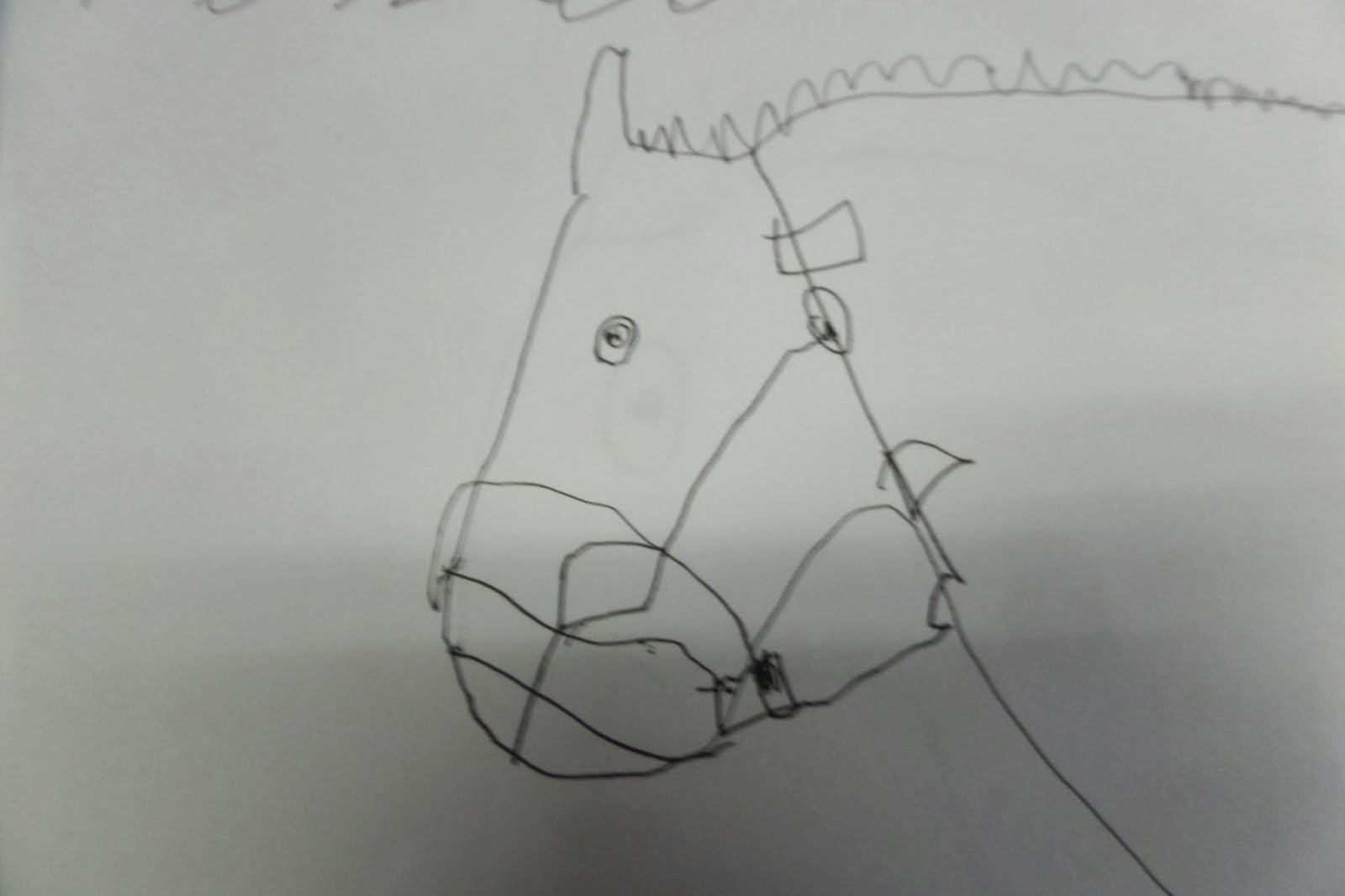 |
| A's drawing of the horse. Pretty good observation. |
 |
| L's second drawing of the horse. She was definitely paying attention. |
104-
J, drawing the chicken- Do you know we eat chickens?
A- No, we don't!
J- Yes. And we eat the babies as eggs.
J2- I smashed the babies once- the eggs.
J- I had a farm behind my house in Puerto Rico. I had a lot of dogs- five of them. Having a farm is fun! Chickens lay eggs.
J2- They warm the eggs up. Then the eggs open!
A- They rip open and the babies go, "peep, peep, peep!"
They decide to draw the dog next.
J2- The dog's face is more like a horse, not a circle. I know a lot about drawing animals now.
Teacher- What else did you learn?
M- I learned that ponies are not the same as horses. Their hair is not the same.
Teacher- What else is different?
J- Ponies are girls and horses are boys.
M- No, because one pony was a boy.
I flip to a photo of the ponies and horses together.
J- The ponies are white. The horses are black. Ponies are smaller than the horses. Horses are bigger.
M- The ponies have hair and the horses do not.
 |
| Photo for observation |
 |
| J's chicken |
 |
| J2's chicken |
 |
| A's horse is pretty good! |
.jpeg)