Español

Friday, October 18, 2013

Friday, October 18, 2013

120, bilingual first grade.  I took a group to the atelier for the first time.  We painted their portraits.  They loved it.  They were mindful about how they held the brushes and really tried to stay true to the effort they put into the portraits (this was their third draft.)  I'm really proud of the first one, as this student didn't want to draw a portrait in the first place, and he didn't want to paint it today, but it ended up being really successful and he left with the biggest smile on his face.

116, bilingual second grade.  I took a second group outside to study clouds.  They had the benefit of seeing their classmates' cloud mural and between that, the study of clouds and a desire to one up their friends, they made an incredible cloud mural on the first try.  Their classroom will now have two walls with clouds.  

108, monolingual first grade.  I pushed in yesterday and today, trying to get ideas for a project.  This is the dialogue I documented as students tried to turn their classroom kitchen into a restaurant, as part of their theme of community helpers and rules. 
108 is talking about community helpers in various locations.

S1- Sometimes you give the person at mcdonalds money and you buy the food. They give you your food on a plate. No, on a tray or in a bag.

S2-The chef cooks the food and the waitress and waiter bring it to you.

Teacher- The kitchen group will be making a restaurant for their community experience at the stations today.

S1-This is a Chinese restaurant.
S2- No, it's a Mexican Chinese restaurant.
S1- I'll be the waitress and you be the customer and they are the chefs.
S1- what would you like today?
S2- I'm the waitress
S1- A boy can't be a waitress.
S2- I’m the waiter.
S3- I want a taco.
S2- She wants a taco.
The waiter goes to the kitchen to tell the chef. Then he, the waiter, starts to "cook."
S4 is the chef, but she seems to be playing alone and not part of this game. The waiter brings the customer a rubber taco. She eats it and decides to be a cook and a waitress, too.
A fifth student is acting like a bus girl, setting the table, cleaning it up and resetting it. She seems uninterested in the game, too. I’m seeing parallel play.
A teacher's assistant comes in and they ask her what she'd like to eat.
S5 decides she's the hostess and sits the new customer at the table.
S2 takes her order to the chef. Now that they have a real customer, everyone is interested in their jobs.

Continuation the following day…
We talked about yesterday's experience and how the roles in the community all need to be filled, because each role is important.
Right away, the restaurant had a couple of chefs, a waitress, a cleaner, and no customers. This concept- that all roles are important- is something they are struggling with.

I thought it might be more fun if they had a menu to order from, so I mentioned this to the students and the art station decided to write and draw some menus. This ended up being awesome because they worked on their ELA skills while contributing to their community, which made them feel like they had a true purpose.

Meanwhile, in the restaurant, student 1 was a customer for a few minutes, but then decided that there was a huge fish tank in the restaurant, so the fish he ordered to eat then swam around the pretend fish tank. 

An art table student came over to see what the restaurant offers. These graphic designers (an artistic profession, NYS art standard 2) were doing a great job at being community helpers.

At this point, the restaurant turned into a fish market, as student one started selling fish out of the fish tank for pretend money.

Two students decide to be Santa and Mrs. Claus and they would be the customers. The graphic designers presented their menus to the restaurant staff and the staff approved the designs. This combination of character play and menus made the customer a desirable role. The fish market staff became the chefs, and we only had one waitress. This is a functional restaurant now.

118, monolingual second grade. I took the last group outside to draw a part of our community.  We chose Elk Street, looking at an old factory building, houses and trees. The students chose a part of the street to represent.  This was a very hard drawing exercise, harder than the other subjects, because there was so much to take in.  I think they had a good attitude and really gave it a good shot.  I will have to address viewpoints again, as I got great viewpoints of the factory and houses, but the cars were difficult to place and I see some bird's eye views.

Our view


Thursday, October 17, 2013


116, bilingual second grade.  The group who painted the clouds came to the studio to work on their mural again. Upon taking a second look at it, and at the cloud pictures we'd taken that day, the students felt frustrated and didn't feel that it was their best effort. They asked if they could redo it. I felt torn- the art teacher in me didn't want to waste the paper, but Ron Berger's voice was ringing in my ears, talking about quality of work and making more than one draft.  I agreed, if we promised to put the first mural to good use on another day.  They agreed and eagerly took to work.  They loved the results of the second draft.  

This is part of a project on Community.  We aim to display the community of School #33 around the second grade classrooms.  The students in 118 have been working on observational drawings of the school and the surrounding buildings. 116's mural will feature living and non-living things that the students research and create.

The rejected mural.  "There's too much gray." 


"It's beautiful." 

Here is some dialogue we had about community while they were working:
Community

T- What were some of the living things in our community?
S1- Animals- cats
S2- We should do a Buffalo!
T- Do Buffalo live in Buffalo?
S2-Yes, on the mountains?
T- Is that in the city?
S2-Yeah, off the Thruway.
T-Is that our community here?
S2-Yeah... Wait, no. No.
S3-I think we need a bee hive!
S4-And a spider!
S3-We could do that for Halloween!
T- Do spiders only live at Halloween?
S3-No. They live every single day.
T-What are some non-living things in Buffalo?
S5-Piñatas.
S4-Trees!
S1- Trees are living. And they give us paper.
S2-Paper is made of trees, but paper is non-living.
T, looks out of the window.  S1 catches on and, soon, others look out of the window, too.
I see cars.
Dead leaves.
Houses.
Windows.
A fence.
Chairs.
Grass.
Grass is living.
My shoe is non-living.
T- Are flowers?
Flowers are living.
Garbage.
T- Do we see garbage outside?
Yes.
T- Who takes care of that?
The people who pick up trash.
And the recycling truck.
They are community helpers.
T- Who else keeps our community nice?
The police.
T- What is their job?

To check if someone is robbing you.
"It's perfect now." 


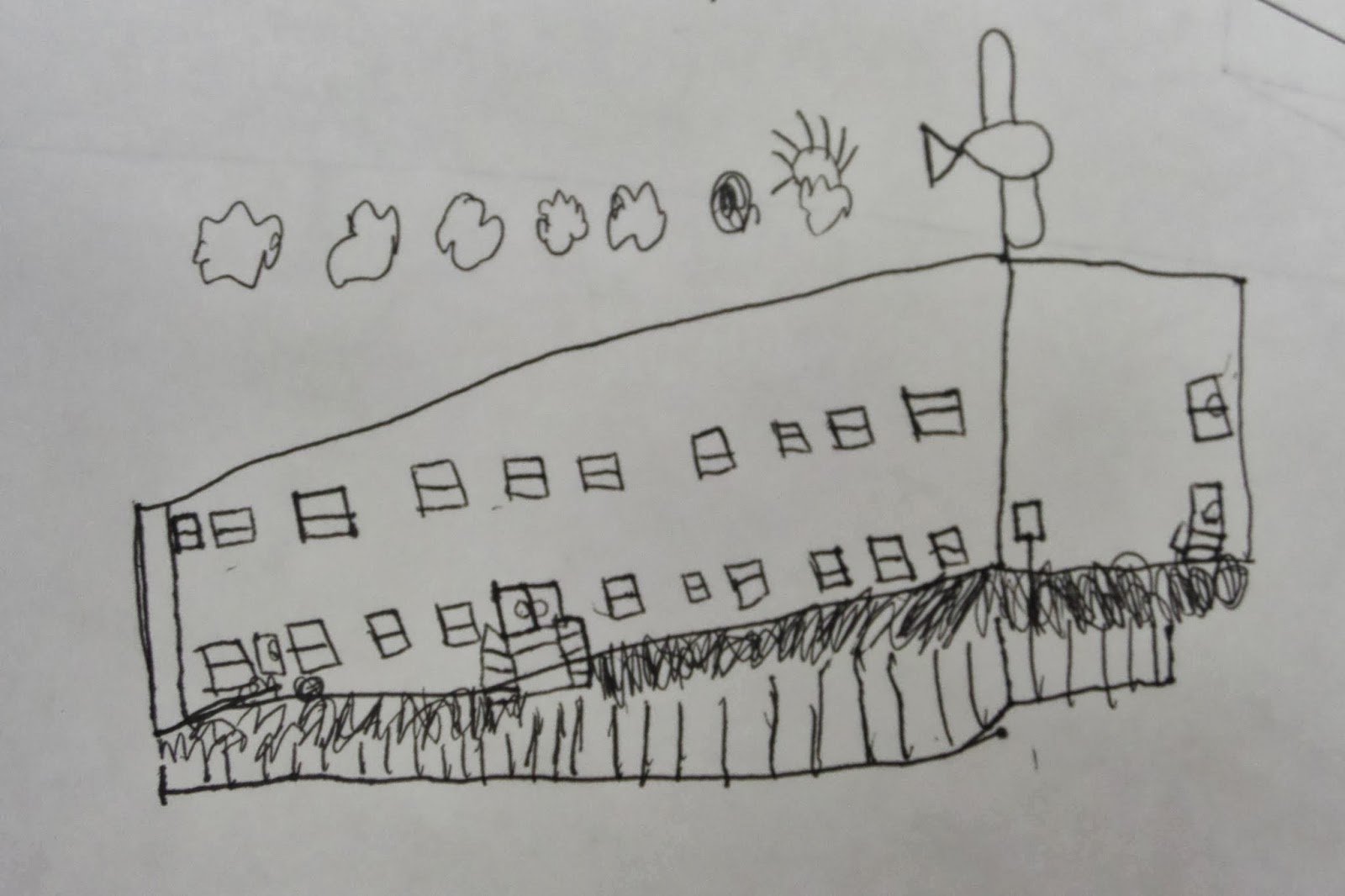
118, monolingual second grade.  Speaking of the Community project, I took a group from 118 outside to draw the school.  Since they are learning to measure using single objects in math class, I showed them how they can "measure" a subject using their pen.  The corner of the school closest to us was two and a half pen lengths tall, but the far end of the school was only one pen length tall.  By holding up their pens to measure the sizes and angles, they were able to see and attempt to capture difficult perspective. I'm really impressed with this first piece.  Take a look at it, compared to the photograph of the school.


"I know I can only draw what I see, but the airplane is flying over, so I can draw that, right?"

The photograph cuts off the top, but this student does have a good angle on the right side of the building.


101, preschool- I had the students explore color mixing for the first time using fingerpaints, like I'd done in 103. The exclamations of "look! I made green!" were exactly what I expected and we'll move onto the tempera paint exploration next.

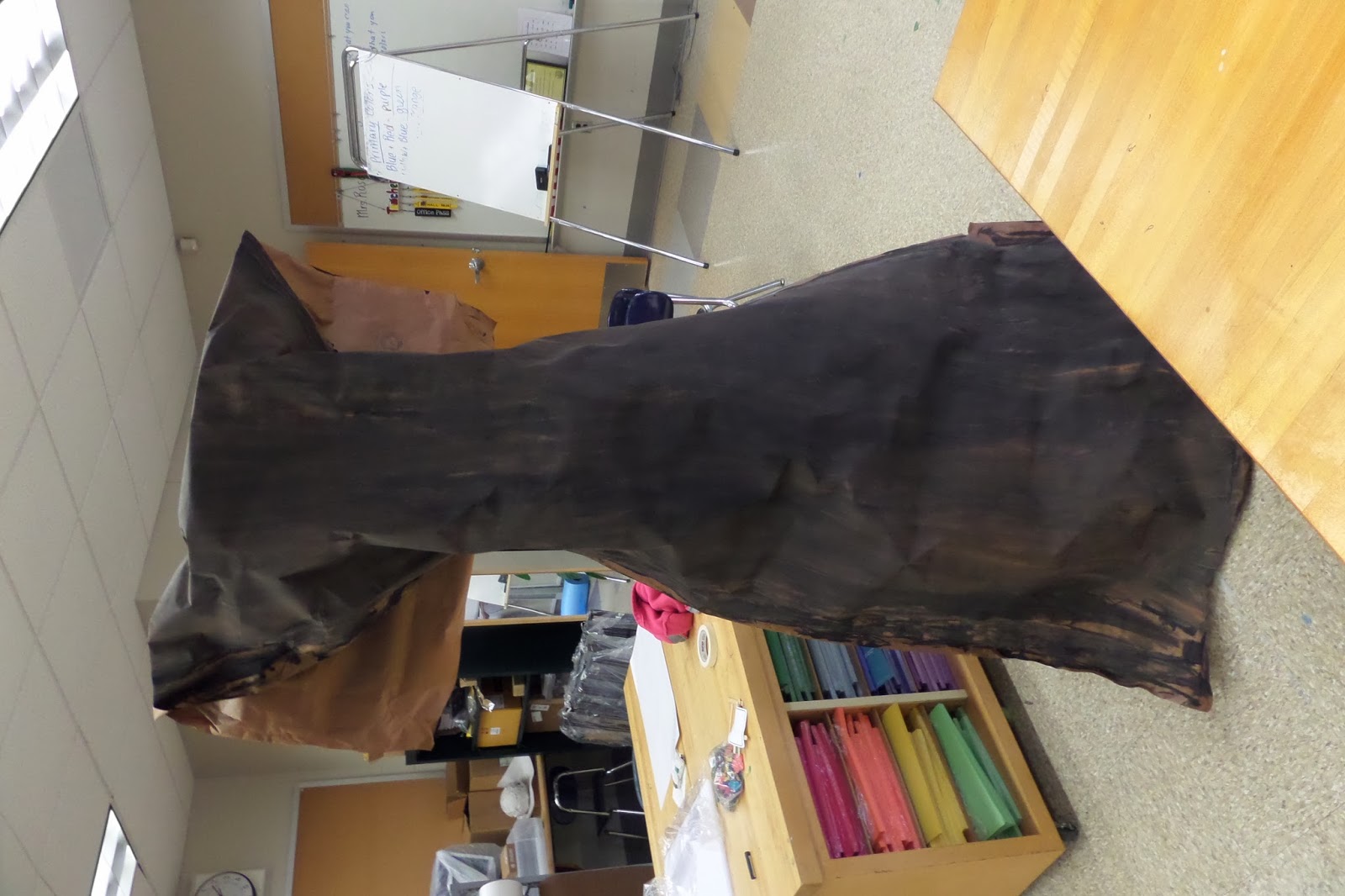
104, bilingual kindergarten. The students are really interested in nature, so they wanted to make a classroom tree.  We made the trunk out of a huge sheet of brown paper with black and multiple shades of brown lines painted on it with roller brushes, to mimic the look of bark.  

                                    
When the students came in today, I asked them about the branches. They said, "They are sticks."  I asked how we should make them, but they didn't have any ideas.  We looked at photographs of trees and saw that the branches start thick and get smaller as they branch off the original trunk.  One student said, "I think we should roll the paper to make the branches!" which is exactly what I was thinking, but I didn't want to run the show.  I asked him to demonstrate and gave him a huge piece of brown paper.  He rolled it and then asked for paint to make the bark.  He showed his friends and soon everyone was rolling and painting branches.


Wednesday, October 16, 2013

Wednesday, October 16, 2013


I had to give the first and second students a pre-test for our state mandated evaluation process, so the morning wasn't filled with the usual educational excitement I'm lucky enough to experience every other day.

103, pre-k- The class continued their exploration of paint by creating green paintings out of blue and yellow paint with roller brushes.  Instead of regular rollers, however, these had squares, circles, wavy lines, hearts and stars, so the experience wasn't the same as the last class when we used red and yellow to create orange.  Last time, I added leaves and twigs to the supplies to see what the students would do.  Today, I had wood shapes.  The students pressed the shapes into the paper and painted over them.  This left an imprint of the shape in either the color of the paper, or the color of whichever layer of paint they were on when they laid the shape down.  The images are really interesting.  One table had their titles figured out before I even came to the table- they enjoy naming their work and I think they are growing immensely already!


104, monolingual kindergarten- I took the second half of this class to create their primary color paintings with black and white shapes.  We made guesses as to which colors would be created by mixing the primary colors- I explained how all scientists make predictions before they experiment. I wrote their guesses on the board and the paint mixing commenced. The giggling that goes on in the studio is the most amazing sound, and there was plenty to be heard today. "Oh!  Oh, it makes green! I didn't guess green!" "Look!  This made purple!" "When you mix them all, you get brown!" Definitely a rewarding end to the day.  I am going to have them critique the paintings next time and then give them the chance to work with the paint again, to see what changes are made.

Tuesday, October 15, 2013

Tuesday, October 15, 2013


118, monolingual second grade- I took half of the class to work on their portraits. They are a really fun group and the portraits look pretty good. They will be finished after one more class.  (See the last photo for both the portraits and the kindergarten tree trunk.)

112, self-contained class- I took half of the class to paint their globes. I gave them paint and three tools- a roller, a flat brush and a small round brush. It was interesting to see them figure out which brush was best for which purpose. They told me that the roller is the quickest way to cover the balloon and the brushes work for the small parts. I asked for comparisons about painting the paper mâché globe versus the self-portrait and they said this was easier, though messier.

108, monolingual first grade- I took a small group to work on playground drawings.  This group made me really proud because they are already critiquing each other in a natural and kind manner.
Some dialogue:
"They made it too fat and I made it too skinny!"
"That's okay. I made mine too big!"
"I'm just going to cross it out.  You can always do another draft."

We discussed how many colors appear to exist on the dark green slide- white, light green, dark green, black- but how the colors are really just the product of the sunlight and shadows. They are learning to "see" like an artist.  I expect this group, especially, will make great strides this year.

120, bilingual first grade. I worked with small groups.  The students drew portraits of community helpers- doctors, construction workers, teachers, police officers, etc.

102, monolingual kindergarten- We continue our exploration of materials with a class jam-packed with painting concepts.  The students received three primary colors and roller brushes.  They guessed which colors would form when the primary colors were mixed.  Most guessed correctly, which is great because it means they already knew the information. After they played with the color mixing, I gave them black and white and asked them to paint geometric shapes on top, so we were able to review geometric shapes and see how tints and shades are created.  The paintings are fabulous.  I love them. :)

104, bilingual kindergarten- The students are working on an inquiry about trees and nature.  We are creating a huge tree to hang in their classroom. Today, we painted the trunk.  The students were given a choice of roller brushes, sponge brushes and paintbrushes, a huge piece of brown paper and black and brown paint.  We looked at the lines on a piece of bark we'd brought in from a dead tree outside and the students tried to mimic the lines on the bark.


Friday, October 11, 2013

Friday, October 11, 2013

120, bilingual first grade. I finished the drawing stage of self-portraits with this class.  Now, I'll start taking them one small group at a time to the studio to introduce them to my room and learn their basic painting skills as they paint their portraits.

116, bilingual second grade.  The second graders study "Community Helpers" as part of their theme for social studies.  To hit upon that, as well as bringing in science, ELA and art components, Mrs. Driscoll and I are going to have the students turn their classroom into the community, featuring living and non-living parts of our community (which the students will research, draw, paint and share out about) and a mural background that covers the walls of the room. Today, I took a small group outside to look at the clouds.  The sky background will be the first step of the mural.  We talked about the colors of the clouds, the shapes, and the way the clouds look as a backdrop for the buildings.  The students were thrilled to see an airplane flying over us, leaving a trail of white "clouds" behind it. We watched the airplane's clouds look like they were dripping down after a few minutes.  "It looks like a caterpillar now," one student exclaimed.

The students reviewed some photos I took of the clouds from our walk and then we rolled out a huge piece of blue paper- it ran the entire length of the studio, so it was probably 25 feet or so long. They noticed that the clouds near the "bottom" (the buildings) were gray, but the clouds higher up in the sky were white, so they divided themselves into two groups.  One group stood on one side of the mural, painting the clouds white, and the others work opposite them with gray paint.

The airplane and the clouds it created showed up on the mural.


At the end of the class period, I asked the students to stand up and look at their work.  I asked them to tell a partner what they liked about the mural and to suggest one thing that they think could make it better.  Everyone agreed that the people painting gray at the end of the painting were using too much gray and that area needed more white clouds.  I thought the same thing, but I didn't have to say a word.  They are starting to critique themselves in a productive way, instead of making fun of each other or saying, "I can't do it- I quit!" This class period was a win.

112 self-contained class.  I showed the students Google Earth on the iPad.  We zoomed in from Earth to our school.  This was really fun for them.  It reinforced their social studies lesson.  We zoomed out as we identified our school, our city, our state, our country and our continent.  They wanted to explore the other continents, so we looked at African and zoomed in to see the differences. (The roads are mostly dirt roads, they have deserts and jungles.)  Then, we traveled to China, which looks more like the United States from above. We looked at the oceans and Antarctica's snow.  Now I feel that the students will be more comfortable painting their paper mache globes during the next class and I think this put the social studies concepts in a clear perspective for them.

103 preschool.  We continued our exploration of paint by using only two colors- red and yellow.  I gave each student paint rollers and leaves.  I asked them to predict what color would be created when the two primary colors were mixed.  As they rolled the colors together, they exclaimed, "Orange!  It made orange!" Every student had a clear understanding by the end of the class that red and yellow make orange.  They painted with the leaves, with the sticks that the leaves had been hanging from, and with the rollers.  Some students wanted to glue their leaves to the paper.  Some printed with their leaves.  Some painted around the leaves, leaving the outline of the leaf.  The results are really great for Autumn. 


104 kindergarten.  We went outside and explored the bark of trees.  We saw two trees that had been cut down and discussed the differences between the dead tree stumps and the living trees. The students made rubbings of the tree stumps.  We are going to be creating a classroom tree in the corner of their room, so this exploration gave them an understanding of the texture of the trees.  We'll paint the tree bark on the trunk of their classroom tree next class.
And we saw a grasshopper, which was very exciting.


Thursday, October 10, 2013

Thursday, October 10, 2013

120, bilingual first grade- We continued with the paintings and I saw more students interacting with the brushes- twirling the brushes, etching designs into the wet paint, layering the paint over and over again.

112, self contained class- The students were bored with the idea of drawing the continents, so we decided it would be more exciting if we painted them on 3D globes.  We used papier mache on balloons to make our planets.  One student wanted to make the moon, so I think the next step will be to research which planet they want to create, instead of forcing everyone to do the Earth.  This way we can have them read and write about their planet and share out, tying in reading and writing standards.


108, monolingual first grade- The playground has a new gate and the gate is locked with zip ties until we get a handle for the gate.  Good thing I took a photograph of the playground yesterday! We sat in a small group and drew from the image on my iPad.  I tried to show the students that we can't see everything on the playground from the photograph and it's not okay to make up what they see when they are drawing like a scientist. ("Can we draw children?" "I'm drawing hearts around it.")   They seemed to understand, but it's not the same as drawing from life.  I wanted to critique the work, but the students need more practice with critique.  I've made a note of it and we'll try again next time I see them.


118, monolingual second grade.  I took the students outside to choose another part of the community to draw, since their peers drew the playground yesterday.  They chose the old church next to the school.  I liked the way they described the shape of the tower:

It looks like a bounce house!
I see a rocketship!
I think it's like a witch's hat!

I didn't push colored pencils on them this time, instead preferring that they just concentrate on the pen drawings.  I think this was a good idea.  Yesterday, I had the students drawing and coloring and something was lost in the rush.


101, preschool. We finished our alphabet book!  Then, we constructed projects with pipe cleaners and popsicle sticks.  At the end of the class, the students voluntarily put their materials away and only one student wanted to keep his.  I thought that was interesting.  They are getting used to using materials and there is an understanding that the materials are for the group, not for the individual to take home.  I think this is a good sign for our Reggio program.  The group and the materials obviously mean something to the students.

Here is a preview of the School #33 Pre-K and Kindergarten Spanish-English Picture Dictionary:


103, preschool.  I took the other half of the class to use finger paints.  It was just as much fun as the first time. I think these are really beautiful pieces of abstract art.  The focus is on the experience, not the finished project, and there's beauty in that.

Untitled

Untitled

Rainbow

Castle

Dinosaurio

Agua